When comparing sand filter vs cartridge filter, many articles focus on technical specifications or simplified comparison charts. In real-world water treatment projects, however, filtration decisions are rarely made in isolation. Engineers, OEM brands, and system designers evaluate filters based on water source conditions, operating stability, lifecycle cost, and downstream protection requirements.
From a filter cartridge manufacturing perspective, the sand filter vs cartridge filter discussion is fundamentally about system role, not product superiority.
Filtration Decisions Start with Raw Water, Not with the Filter
In practical applications, filtration selection always begins with one question:
What does the incoming water actually contain?
Surface water, municipal tap water, groundwater, and industrial recycled water all carry very different contaminant profiles. High turbidity, visible particles, or seasonal sediment spikes immediately change the filtration strategy.
In systems where suspended solids fluctuate or particle loads are unpredictable, engineers rarely rely on cartridge filters alone. This is where sand filtration is introduced—not as a polishing tool, but as a load-reduction stage.
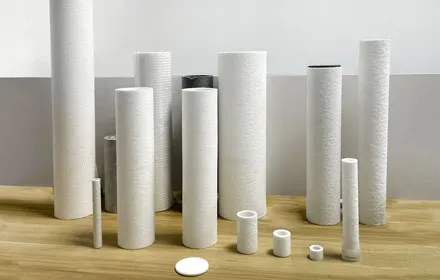
In practical systems, sand filtration reduces the bulk particle load, while PP sediment filter cartridges are commonly applied downstream to provide consistent micron-level particle control and protect finer filtration stages.
This context is often missing in generic sand filter vs cartridge filter discussions.
Why Sand Filters Exist in Modern Systems
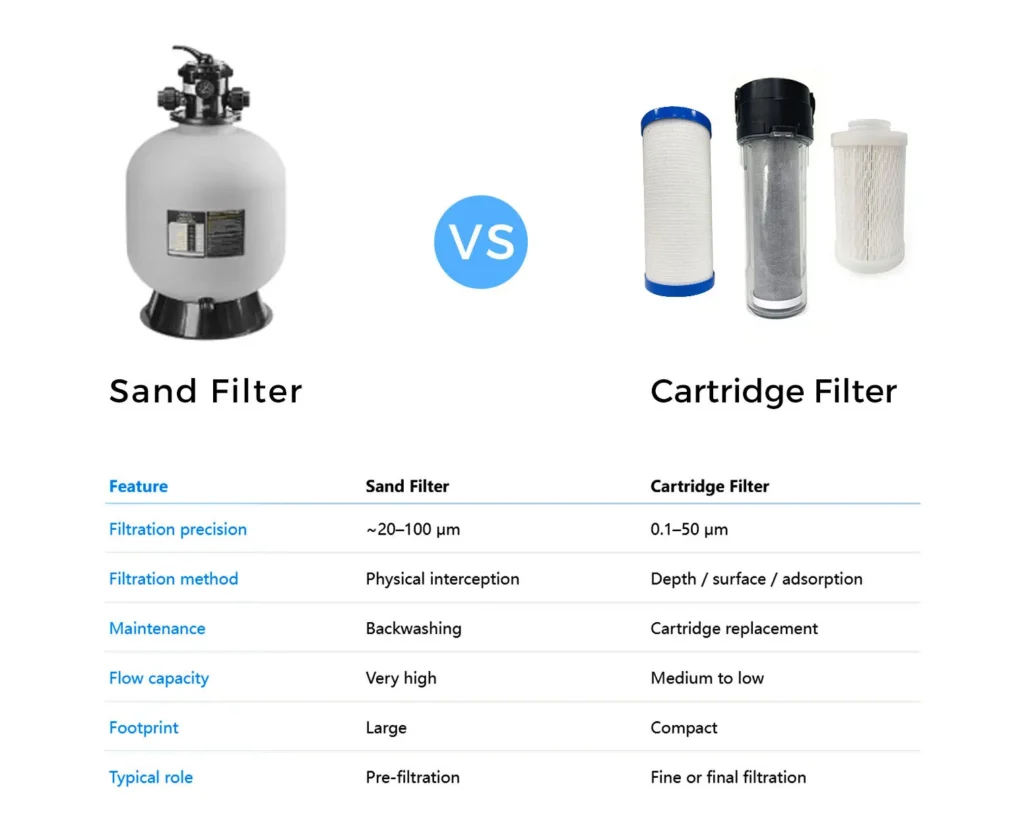
Sand filters remain widely used because they solve a specific problem that cartridge filters are not designed for: handling volume and variability.
A sand filter can tolerate:
- Sudden increases in turbidity
- Continuous high-flow operation
- Infrequent maintenance intervals
Its ability to be cleaned through backwashing makes it suitable for upstream positions where contaminant loads are heavy and inconsistent. In these conditions, using cartridge filters as the first line of defense would result in rapid clogging and unstable system performance.
From an engineering standpoint, the sand filter functions as a buffer, stabilizing water quality before precision filtration occurs.
Where Cartridge Filters Add Real Value
Cartridge filters are selected not because they are smaller or more convenient, but because they deliver predictable filtration performance.
Unlike sand filters, cartridge filters are manufactured with controlled pore structures and material specifications. This allows system designers to target:
- Specific micron ratings
- Chlorine and organic compound reduction
- Taste and odor improvement
- Final water clarity at the point of use
In drinking water and residential systems, this level of consistency is critical. Consumers experience water quality directly, and small variations matter.
This is why cartridge filters typically appear after sand filtration in multi-stage systems.
The Hidden Cost of Treating Sand Filter vs Cartridge Filter as Alternatives
One common system design mistake is treating sand filters and cartridge filters as interchangeable options. In practice, this leads to two predictable failures:
- Overloading cartridge filters
When cartridge filters are forced to handle high particulate loads, replacement frequency increases sharply, raising operating costs. - Overestimating sand filter performance
Sand filters are effective at particle removal but do not address chlorine, odor, or dissolved organic compounds, which are critical for drinking water applications.
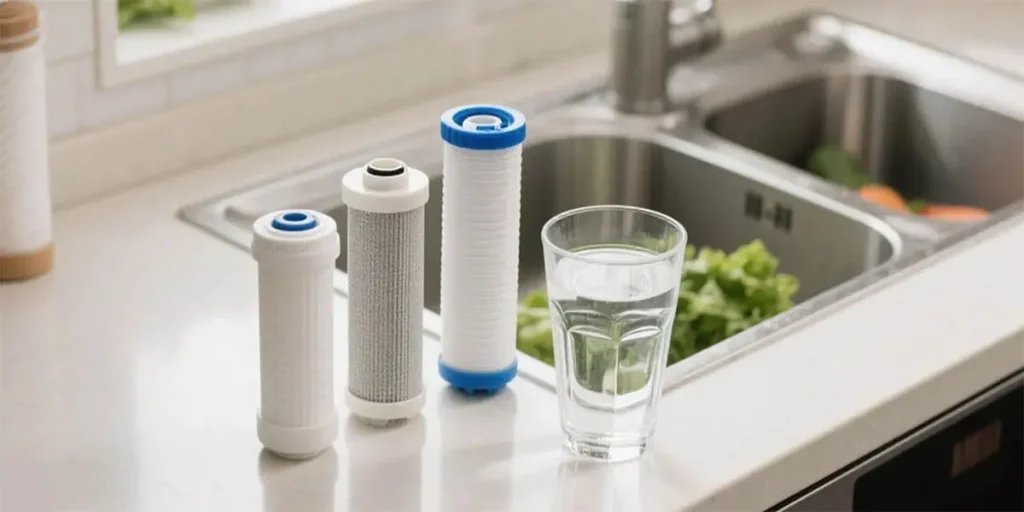
For drinking water systems, these functions are typically handled by activated carbon filter cartridges, which are designed for chlorine reduction, taste and odor improvement, and fast adsorption performance.
Understanding these limitations is central to a meaningful sand filter vs cartridge filter evaluation.
How Experienced Engineers Combine Both Technologies
In professionally designed systems, filtration stages are layered based on function:
- Sand filters manage quantity and variability
- Cartridge filters manage precision and consistency
A typical configuration follows a logic path rather than a fixed formula:
Raw water conditions → Load reduction → Precision filtration → End-use requirements
This approach reflects decades of industry practice and explains why sand filters have not been replaced by cartridge filters, despite advances in filter media.
A Manufacturer’s Perspective on System Reliability
From a cartridge manufacturer’s standpoint, system reliability is directly tied to proper positioning of cartridge filters. When upstream filtration is correctly handled by sand or multimedia filters, cartridge performance becomes stable, predictable, and cost-effective.
This alignment between system design and filter capability is what separates engineered solutions from product-driven installations.
Conclusion
The real discussion around sand filter vs cartridge filter is not about choosing one over the other. It is about understanding how each technology fits into a complete water treatment strategy.
Sand filters address the realities of raw water variability and high-flow demands. Cartridge filters deliver the precision and consistency required for final water quality. Systems that recognize and respect these roles achieve longer service life, lower operating costs, and more reliable performance.
In most systems, cartridge filters are selected based on downstream requirements such as chlorine reduction or fine particulate control.