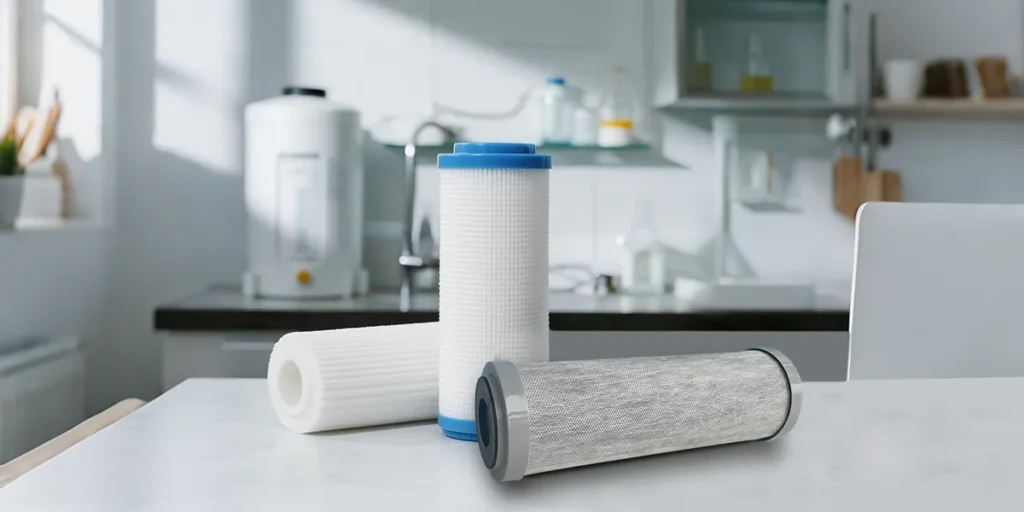
Manufacturers prefer ACF (Activated Carbon Fiber) in high-end water filters because it enables fast adsorption under short contact time, lower pressure drop in compact systems, cleaner structural stability, and greater design flexibility compared with traditional carbon media.
These advantages make ACF especially suitable for premium, space-constrained, and performance-driven filtration products.
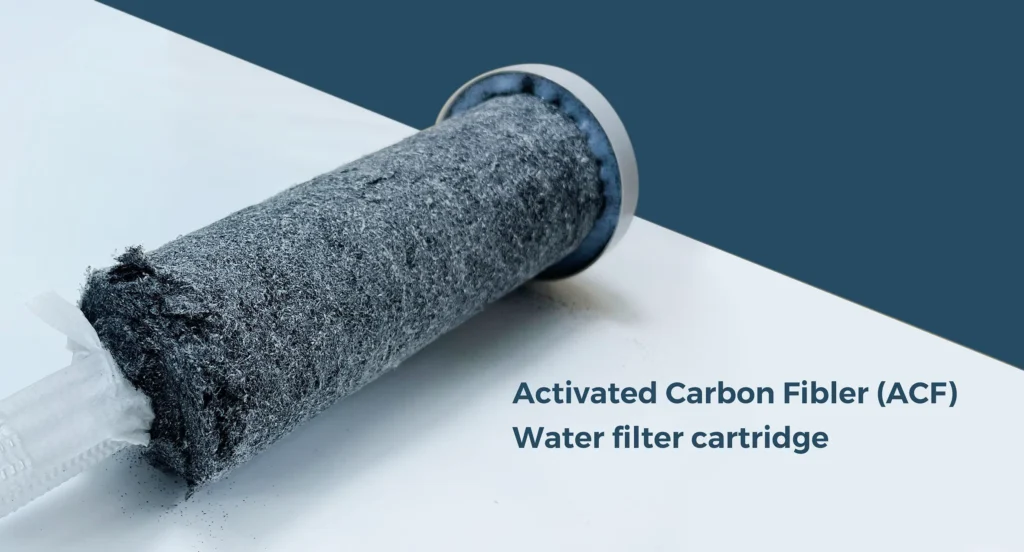
ACF as a Material Choice in High-End Filter Design
In high-end water filter development, manufacturers focus less on basic filtration capability and more on how a material behaves under real-world design constraints—such as limited space, high flow expectations, and strict user experience requirements.
From a manufacturer’s perspective, ACF is not selected because it is “new” or “different,” but because it solves multiple design and performance challenges simultaneously in premium filtration systems.
Faster Adsorption Under Short Contact Time
High-end water filters often operate with short contact time, especially in compact point-of-use systems.
ACF is favored by manufacturers because:
- Adsorption occurs directly at the fiber surface
- Contaminants are captured rapidly upon contact
- Effective performance is maintained even at higher flow rates
Compared with granular carbon media, ACF delivers more predictable adsorption efficiency when space and dwell time are limited—an essential requirement in premium designs.
Lower Pressure Drop in Compact Filtration Systems
Pressure drop is a major constraint in high-end water filter engineering. Excessive resistance negatively affects flow rate, system compatibility, and end-user satisfaction.
ACF supports:
- High porosity and open flow paths
- Uniform water distribution
- Stable performance across varying flow conditions
As a result, manufacturers can design slim, compact cartridges without compromising flow performance—something that is difficult to achieve with dense carbon block structures.
Cleaner Structure and Production Stability
From a manufacturing and quality-control standpoint, material stability is critical.
ACF offers:
- Minimal carbon fines release
- Reduced need for extensive pre-flushing
- Improved consistency between production batches
This cleaner structure simplifies assembly, reduces downstream complaints, and supports more stable large-scale OEM production, which is especially important for premium brands.
Design Flexibility for High-End Filter Cartridges
High-end water filters are increasingly expected to combine performance, compactness, and refined product design.
Manufacturers value ACF for its ability to:
- Be pleated to increase effective surface area
- Integrate seamlessly with PP melt-blown prefiltration layers
- Support custom cartridge shapes and slim housings
This flexibility allows product designers to achieve modern, space-efficient designs while maintaining high filtration performance.
Manufacturing Consistency and OEM Advantages
Consistency is a core requirement for OEM and private-label production.
Compared with traditional carbon media, ACF provides:
- More uniform adsorption behavior
- Easier control of key production parameters
- Predictable performance over the product lifecycle
These characteristics help manufacturers meet international quality standards and customer specifications with fewer performance variations.
When Do Manufacturers Choose ACF Over Other Carbon Media?
Manufacturers typically prioritize ACF in scenarios such as:
- Premium point-of-use drinking water filters
- Faucet and countertop filtration systems
- Shower filters requiring high flow and low resistance
- Compact under-sink systems with limited housing space
In these applications, adsorption speed, flow stability, and design efficiency outweigh the need for bulk carbon volume.
Summary for Manufacturers and Product Developers
Manufacturers prefer ACF for high-end water filters because it enables:
- Reliable performance under short contact time
- Lower pressure drop in compact systems
- Cleaner structure with improved production stability
- Greater flexibility in premium cartridge design
- More consistent outcomes in OEM manufacturing
As the market continues to move toward high-performance, space-efficient, and premium-positioned water filtration products, ACF remains a strategic material choice for manufacturers focused on the high-end segment.