Turbidity is one of the most visible indicators of water quality problems. When water appears cloudy, milky, or hazy, it usually means suspended particles are present. These particles may not always be harmful on their own, but they often signal the need for proper filtration.
A common question from system integrators, OEM brands, and end users is:
Does a sediment filter remove turbidity from water?
From a filtration engineering perspective, the answer is yes — sediment filter cartridges are specifically designed to reduce turbidity. However, the degree of turbidity removal depends on particle size distribution, filter structure, and micron rating.
What Is Turbidity?
Turbidity measures how much suspended particulate matter interferes with light passing through water. It is commonly measured in NTU (Nephelometric Turbidity Units).
Typical turbidity ranges:
- <1 NTU: Clear drinking water
- 1–5 NTU: Slight cloudiness
- >5 NTU: Visibly turbid water
- >10 NTU: Heavy sediment or surface water contamination
Sources of turbidity include:
- Sand and soil intrusion
- Pipe corrosion (iron rust)
- Silt and clay particles
- Organic debris
- Disturbed well or surface water
High turbidity can shield microorganisms from disinfection and significantly reduce the efficiency of carbon filters and membranes.
How Sediment Filters Remove Turbidity
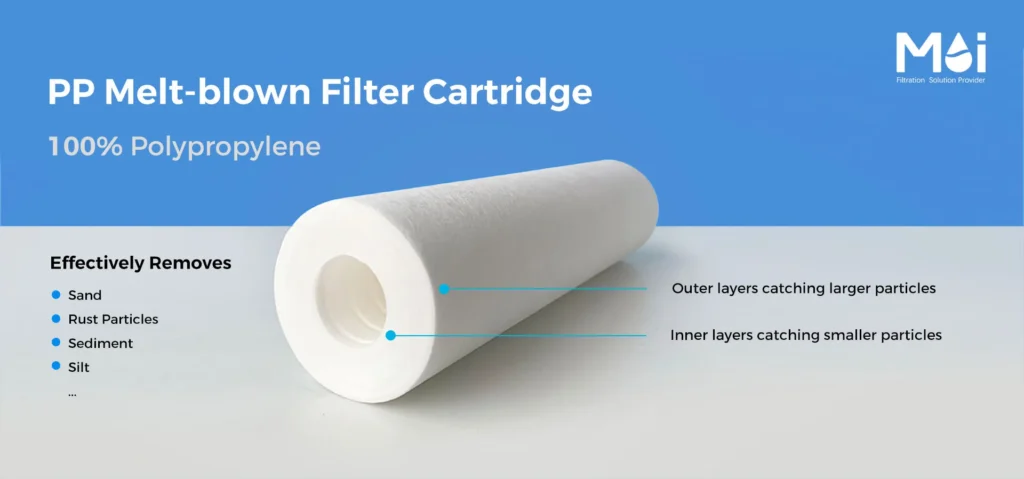
Sediment filters remove turbidity through mechanical filtration. As water flows through the filter media, particles larger than the pore size are physically trapped.
Common sediment filter structures include:
- PP melt blown depth filters
- Pleated PP surface filters
- String wound filters
Depth-type PP sediment filters are particularly effective because particles are captured throughout the filter thickness rather than only on the surface.
In controlled testing, sediment filters can typically reduce turbidity by:
- 60–80% with 20–50 μm filters
- 80–95% with 5–10 μm filters
- >95% with 1 μm filters (for particulate turbidity)
Micron Rating and Turbidity Reduction
Micron rating is the most critical parameter when selecting a sediment filter for turbidity control.
| Micron Rating | Typical Particles Removed | Turbidity Impact |
| 50 µm | Sand, coarse debris | Low |
| 20 µm | Visible sediment | Moderate |
| 10 µm | Fine sand, rust flakes | High |
| 5 µm | Silt, fine particulates | Very high |
| 1 µm | Fine suspended solids | Excellent |
For residential and light commercial systems, 5μm PP sediment filters are the most commonly used balance between clarity improvement and acceptable flow rate.
Flow Rate and Pressure Drop Considerations
Reducing turbidity more aggressively usually increases pressure drop. Typical performance ranges for 10” PP sediment filter:
- Flow rate: 2–4 GPM (7.5–15 L/min)
- Initial pressure drop: 0.05–0.15 bar
- Dirt holding capacity: 10–20g, depending on structure
Pleated sediment filters offer higher flow rates and longer service life in high-turbidity conditions but may require more frequent cleaning or replacement.
Limitations of Sediment Filters
While sediment filters are effective at removing turbidity, they have clear limitations:
- They don’t remove dissolved contaminants
- They don’t remove chlorine, PFAS, or VOCs
- They don’t provide microbiological protection
Colloidal particles smaller than the micron rating may also remain suspended, which is why sediment filters are not a complete water treatment solution on their own.
Role of Sediment Filters in Multi-Stage Systems
In practical water filtration design, sediment filters are used as pre-filtration to:
- Reduce turbidity before carbon block or activated carbon fiber filters
- Prevent premature clogging of UF or RO membranes
- Improve overall system stability
- Extend downstream filter service life by 30–50% in turbid water conditions
Without proper sediment pre-filtration, carbon filters and membranes often experience rapid pressure loss and uneven performance.
Conclusion
So, does a sediment filter remove turbidity?
Yes – the sediment filter element is specifically designed to remove suspended particles in water that cause turbidity, thereby reducing the turbidity.
The turbidity removal rate depends on the types of filter selected, the filtration accuracy (in microns), and the system configuration. For most water treatment applications, sediment filtration is a necessary first step rather than an independent solution.