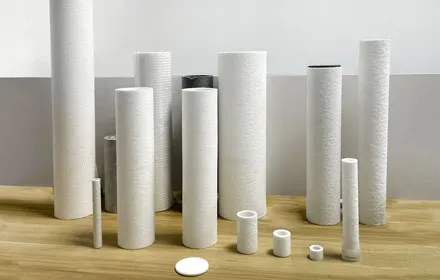
High-Efficiency Solution for Industrial Water Treatment Systems
When VOC contamination starts affecting your water system performance, the issue is rarely just compliance.
It becomes a problem of stability, maintenance frequency, and operational risk.
ACF (Activated Carbon Fiber) filter cartridges are designed for exactly these situations—where traditional carbon solutions begin to show limitations.
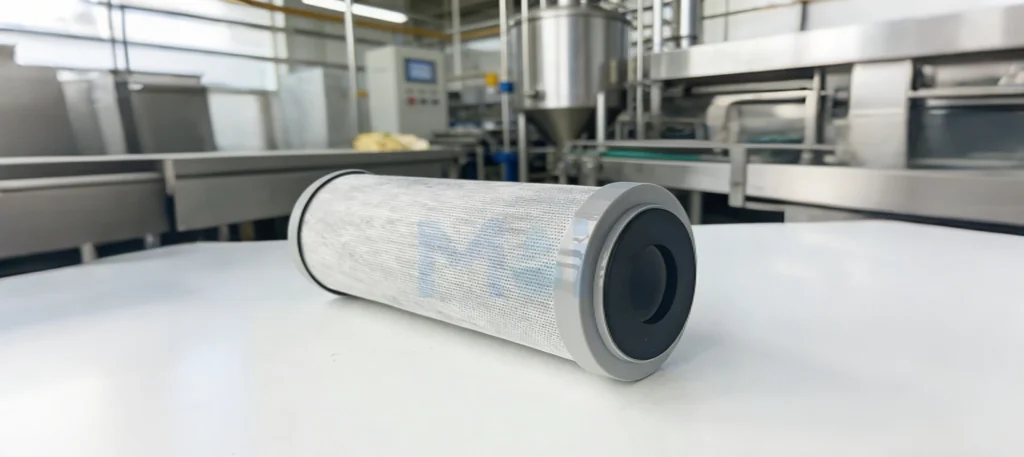
Why More Industrial Buyers Are Switching to ACF Filter Cartridge for VOC Removal
In water treatment applications, performance is not only about adsorption capacity.
It’s about how fast the system reacts, how stable it performs under changing conditions, and how predictable the maintenance cycle becomes.
ACF filter cartridges address these challenges directly.
Compared to conventional granular activated carbon (GAC), ACF delivers:
Faster adsorption rates for dissolved VOCs such as benzene, toluene, and xylene
Higher efficiency at low concentration levels (<10 ppm)
Reduced risk of sudden breakthrough
More stable effluent quality under fluctuating flow conditions
For many systems, this means fewer operational surprises—and fewer emergency interventions.
Testing data from industrial applications shows:
At low VOC concentrations (<10 ppm), activated carbon fiber maintains adsorption efficiency above 90%, where conventional carbon may drop below 70–80%.
At fluctuating flow rates, ACF systems show lower variance in effluent VOC levels, improving compliance consistency.
For buyers, this reduces the need for overdesigning systems just to compensate for uncertainty.
Space Efficiency and System Design Advantages
In many industrial facilities, footprint is a constraint.
Traditional GAC systems often require larger beds to achieve sufficient contact time. This increases equipment size, water retention volume, and system complexity.
ACF cartridges allow for more compact configurations without sacrificing performance.
Because of faster kinetics:
Empty Bed Contact Time (EBCT) can often be reduced from typical 10–20 minutes to 5–10 minutes.
System volume can be reduced by 30–60%, depending on the application.
This becomes particularly valuable in retrofitting projects or modular treatment systems where space optimization directly affects project feasibility.
ACF vs GAC: What Actually Changes in Your System
The difference is not just material—it’s system behavior.
With GAC, adsorption relies heavily on diffusion into deeper pores. This often leads to slower response and uneven utilization.
With ACF, the fiber structure provides immediate access to adsorption sites.
This results in:
- Faster system response to VOC spikes
- More uniform media utilization
- Smoother breakthrough curves
- More predictable replacement cycles
For procurement teams, this translates into better planning and lower operational uncertainty.
Lifecycle Cost vs Initial Cost: What the Numbers Actually Show
ACF cartridges are typically priced higher than conventional activated carbon on a per-unit basis. This is often the first objection during evaluation.
However, procurement decisions rarely stop at initial cost.
When evaluated across a full operational cycle, several cost factors shift:
- Longer effective service intervals due to more uniform adsorption
- Reduced frequency of system shutdowns for media replacement
- Lower risk of compliance failure or process disruption
In controlled comparisons, total operational costs (including maintenance and downtime) have been shown to decrease by 15–35% when switching from GAC to ACF in VOC-sensitive water systems.
This is why many buyers begin to evaluate ACF not as a premium option, but as a risk-reduction strategy.
Where ACF Filter Cartridges Deliver the Most Value in Water Treatment
ACF is not positioned to replace all carbon-based filtration. Its value becomes most evident in applications where consistency and response speed matter.
This includes:
- Process water purification in electronics and chemical manufacturing
- Pre-treatment before membrane systems such as RO or NF
- Wastewater streams with variable VOC loads
- Polishing stages where low residual VOC levels are required
In these environments, performance fluctuations are more costly than material costs.
And that’s where ACF aligns better with operational priorities.
From Specification to Procurement: How Buyers Are Making Decisions
On paper, many carbon materials appear comparable.
But in real procurement scenarios, decision-makers focus on different metrics:
- How stable is performance under changing conditions?
- How predictable is the replacement cycle?
- Will the system require constant adjustment?
ACF filter cartridges tend to answer these questions more convincingly, not by maximizing a single parameter, but by reducing variability across the entire system.
Final Perspective: A Shift Toward Performance Predictability
The move toward ACF filter cartridge in water VOC removal is not driven by trends. It is driven by operational experience.
As industrial systems become more sensitive to contamination and more dependent on stable performance, the tolerance for inconsistency continues to decrease.
ACF fits into this shift naturally.
Not as a universal replacement, but as a targeted solution for applications where predictability, efficiency, and system control are critical.
It moves away from comparing materials—and toward evaluating outcomes.
Contact us for ACF cartridge specifications or customized VOC removal solutions.