Safe drinking water begins long before it reaches your home. Water treatment plants use physical and chemical steps to clean the water. They remove dirt, tiny particles, and harmful germs. One of the most important steps is disinfection. This step kills bacteria and viruses. It stops them from growing inside the water pipes.
Many countries use similar cleaning steps. But they don’t always use the same disinfectants. Some countries rely mostly on free chlorine. Others use chloramine more and more. Chloramine lasts longer and creates fewer harmful byproducts.
Understanding these two options is important for water filter makers and buyers. This is because different disinfectants need different filter technologies.
What Is Free Chlorine?
Free chlorine refers to chlorine that remains available in water as hypochlorous acid and hypochlorite ions. It is one of the world’s most widely used drinking water disinfectants because it rapidly destroys bacteria, viruses, and many other microorganisms.
Advantages
- Fast and highly effective disinfection
- Proven technology used worldwide
- Low treatment cost
- Easy to monitor residual disinfectant levels
Limitations
Free chlorine is highly reactive. When natural organic matter is present in water, it can react to form disinfection byproducts (DBPs), including trihalomethanes (THMs) Haloacetic Acids (HAAs).
According to the U.S. EPA and the WHO, long-term exposure to elevated levels of these regulated DBPs may increase certain health risks. For this reason, water utilities carefully monitor and control DBP concentrations.
What Is Chloramine?
Chloramine is produced by combining chlorine with ammonia. Unlike free chlorine, chloramine is a combined chlorine disinfectant that remains stable for a much longer time inside municipal distribution systems.
Many water utilities choose chloramine because it provides longer-lasting residual protection while generally producing lower levels of regulated DBPs.
Advantages
- Longer residual disinfectant protection
- Lower formation of THMs and HAAs
- Better suited for large distribution networks
- Less noticeable chlorine taste and odor for many consumers
Limitations
Because chloramine is more chemically stable, it is also more difficult to remove. Standard activated carbon may require longer contact time, while catalytic carbon is typically more effective for chloramine reduction.
Free Chlorine vs Chloramine: Key Differences
| Feature | Free Chlorine | Chloramine |
| Disinfection Speed | Very Fast | Moderate |
| Residual Protection | Shorter | Longer |
| Formation of THMs & HAAs | Higher Potential | Lower Potential |
| Stability in Pipelines | Lower | Higher |
| Taste & Odor | More Noticeable | Generally Milder |
| Ease of Filtration | Easier | More Challenging |
Although both disinfectants meet drinking water regulations when properly managed, choosing the appropriate filtration media depends on which disinfectant is present.
How Different Countries Disinfect Drinking Water
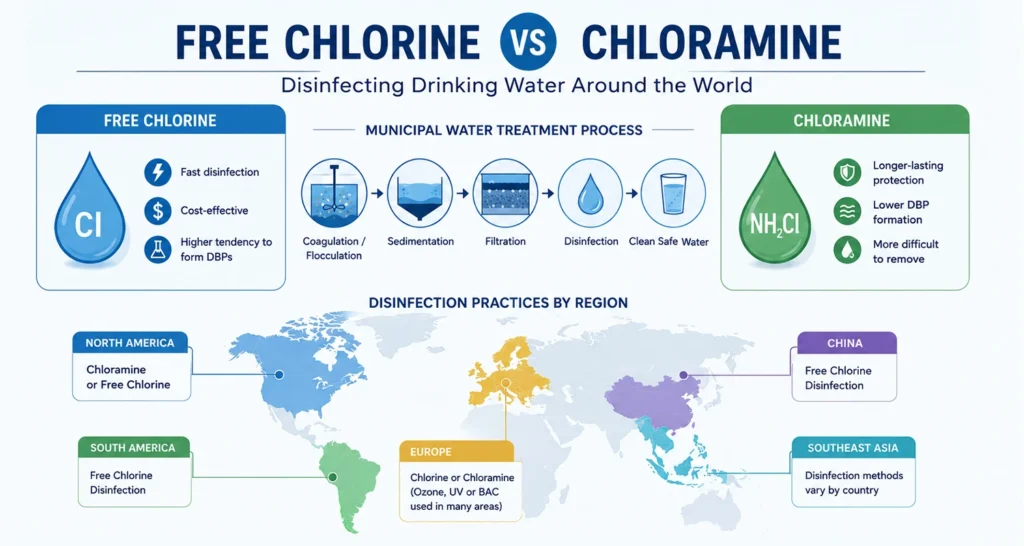
Every country filters and cleans its water, but they choose different ways to disinfect it. Their choice depends on local water quality, laws, and budget.
- China & South America: Most cities use traditional filtering followed by free chlorine disinfection.
- North America (US & Canada): Many large cities have switched to chloramine, though some areas still use free chlorine.
- Southeast Asia: Water systems vary a lot. Different cities choose different methods based on their local pipes and tech.
- Europe: Water treatment here is often more complex. They frequently mix ozone, UV light, or special carbon filters. Some areas add small amounts of free chlorine or chloramine just to keep the pipes safe.
There is no single global standard. Each region picks the best choice for its budget and lifestyle.
Why Free Chlorine vs Chloramine Matters for Water Filtration
The type of disinfectant used directly affects filter performance.
Free Chlorine
Free chlorine is relatively easy to reduce using:
- Activated Carbon Fiber (ACF)
- Carbon Block Filters
- Granular Activated Carbon (GAC)
These media effectively improve taste and odor while reducing residual chlorine.
Chloramine
Chloramine is more chemically stable and typically requires:
- Catalytic Carbon
- Specialized activated carbon formulations
- Extended contact time
- Multi-stage filtration systems
Selecting the appropriate filtration media helps maintain consistent performance and extends filter service life.
Which Water Filter Is Best?
Different filter technologies target different contaminants.
| Filter Media | Free Chlorine | Chloramine |
| Activated Carbon Fiber (ACF) | Excellent | Moderate |
| Carbon Block | Excellent | Good |
| Granular Activated Carbon | Good | Limited |
| Catalytic Carbon | Excellent | Excellent |
| Reverse Osmosis (with carbon pre-filter) | Excellent | Excellent |
For OEM water filter manufacturers, matching filter media to the local municipal disinfectant is essential for achieving the desired treatment performance.
Conclusion
The debate over free chlorine vs chloramine is not about determining which disinfectant is universally better. These two technologies play a critical role in protecting public health and are widely used in municipal water treatment systems around the world.
Free chlorine offers rapid and effective disinfection, but it has a greater potential to form regulated disinfection byproducts when reacting with natural organic matter. Chloramine provides longer-lasting residual protection and generally forms fewer regulated DBPs, making it a preferred choice for many large distribution systems. Because treatment practices vary from one country to another, understanding local water conditions is essential when choosing filtration media. Whether the goal is reducing free chlorine, chloramine, taste, or odor, choosing the right filter technology helps ensure reliable performance for residential, commercial, and industrial water treatment applications.