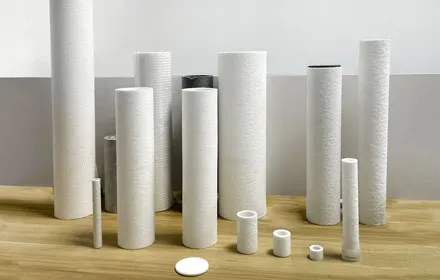
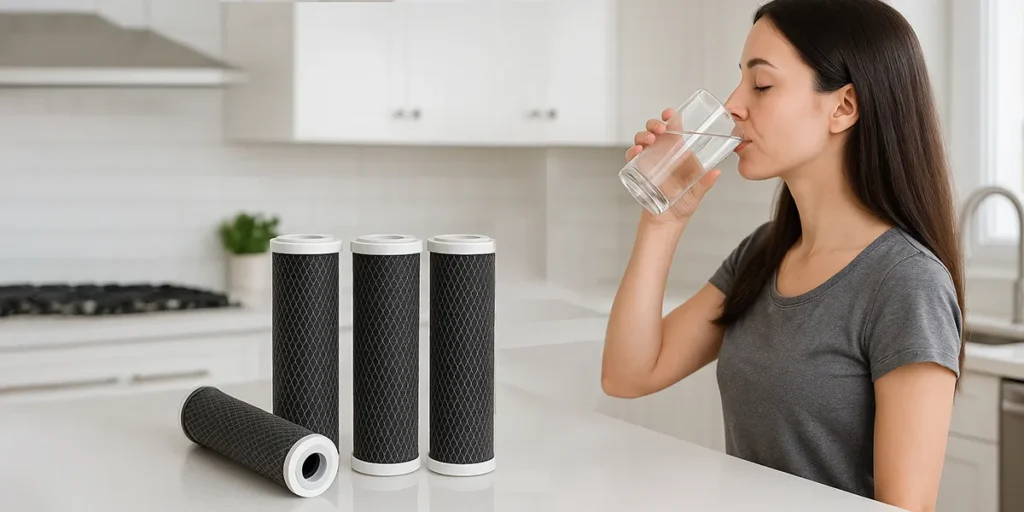
Hard water filter cartridges can help manage hard water problems, but the right cartridge depends on the treatment goal. If the goal is to remove hardness minerals such as calcium and magnesium, ion exchange filter cartridges are required. Standard PP, activated carbon, and UF filter cartridges do not soften water but can improve other water quality issues such as sediment, chlorine, taste, and odor.
Hard water contains high levels of dissolved minerals, mainly calcium and magnesium, which can cause scale buildup, reduce equipment efficiency, and increase maintenance costs.
What Is Hard Water?
It is water that contains high concentrations of dissolved calcium and magnesium minerals. These minerals naturally enter water sources as groundwater passes through rocks and soil. Although hard water is generally safe for drinking, it can cause several problems during daily use and industrial processes.
Common problems caused by hard water include:
- Scale deposits on faucets, pipes, and heating elements
- Reduced efficiency of water heaters and coffee machines
- Shorter service life of appliances
- Mineral spots on glassware and surfaces
- Increased cleaning and maintenance costs
Water hardness is usually measured as calcium carbonate (CaCO₃) concentration. Understanding the hardness level is the first step in choosing a suitable water treatment solution.
Why Hard Water Requires Special Treatment
Unlike suspended particles or chlorine, hardness minerals are dissolved ions that cannot be removed by ordinary mechanical filtration. For example:
- PP filter cartridges trap physical particles.
- Activated carbon cartridges reduce chlorine, taste, and odor.
- UF membranes remove bacteria and suspended contaminants.
However, calcium and magnesium ions are much smaller and remain dissolved in water.
To reduce hardness, specialized technologies are required, such as:
- Ion exchange resin
- Reverse osmosis membrane
- Nanofiltration membrane
- Other hardness control media
Therefore, selecting a hard water filter cartridge starts with identifying whether the goal is removing hardness minerals, reducing scale formation, or improving overall water quality.
Technologies Used in Hard Water Treatment
Different technologies treat hard water in different ways.
Ion Exchange Resin
Ion exchange is the most common technology for true water softening. During the process, water passes through resin beads that contain sodium ions. The resin attracts calcium and magnesium ions and exchanges them with sodium ions. The simplified reaction is: 2R–Na + Ca²⁺ → R₂–Ca + 2Na⁺
This process reduces hardness minerals and helps prevent scale formation. Ion exchange technology is widely used in water softeners, commercial filtration systems, cartridge-based softening systems, and beverage equipment.
Reverse Osmosis (RO)
It uses a semi-permeable membrane to remove dissolved minerals and ions from water. RO systems can reduce calcium, magnesium, sodium, and other dissolved solids. Because RO removes a wide range of dissolved substances, it is commonly used in drinking water purification.
Nanofiltration (NF)
NF is a membrane technology that can partially reduce hardness ions. Compared with RO, NF allows some smaller minerals and beneficial components to remain while reducing larger dissolved ions. It is often used for drinking water treatment and industrial water processing.
Scale Control Technologies
Some technologies focus on preventing scale rather than removing hardness minerals. For example, Template Assisted Crystallization changes the structure of hardness minerals so they are less likely to form hard deposits. Unlike ion exchange, calcium and magnesium remain in the water; total hardness is not significantly reduced. These technologies are mainly used for scale prevention applications.
Can a Filter Cartridge Soften Hard Water?
The answer depends on the filter media inside the cartridge. A hard water filter cartridge may reduce hardness if it contains specialized softening media, such as ion exchange resin. However, many common filter cartridges don’t soften water.
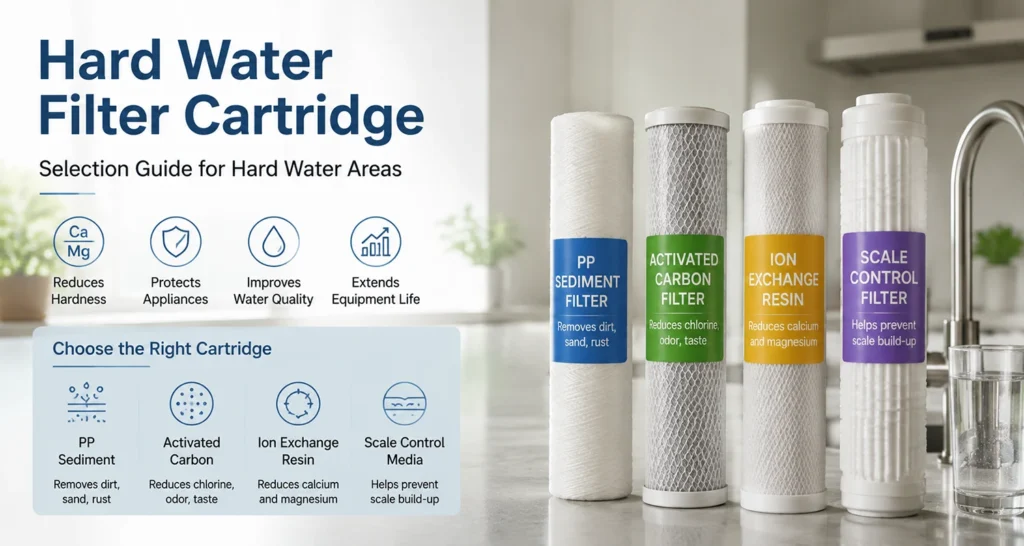
PP Filter Cartridge
They are designed for sediment filtration. Remove: sand, rust, dirt, suspended particles. They don’t remove dissolved calcium and magnesium ions.
Activated Carbon Filter Cartridge
Activated carbon is widely used in water filtration because of its excellent adsorption performance. It can reduce chlorine, taste, odor, and organic compounds. But activated carbon does not remove water hardness minerals. In hard water areas, activated carbon cartridges are often combined with other treatment technologies to provide better overall water quality.
UF Membrane Cartridge
Ultrafiltration membranes remove bacteria, colloids, and suspended solids. However, dissolved hardness ions can pass through UF membranes. Therefore, UF is not considered a water-softening technology.
Types of Hard Water Filter Cartridges
The right hard water filter cartridge depends on the treatment objective.
Ion Exchange Hard Water Filter Cartridge
Ion exchange cartridges contain resin media that exchange hardness ions with other ions. They are suitable for applications where hardness reduction is required.
Common applications include: coffee machines, water dispensers, under-sink systems, and commercial beverage equipment. Their main advantage is that they can directly reduce calcium and magnesium ions.
Scale Control Filter Cartridge
Scale control cartridges are designed to reduce mineral deposits rather than remove hardness. They are suitable when the goal is:
- Protecting heating components
- Reducing maintenance frequency
- Controlling scale buildup
They are commonly used in coffee equipment, ice machines, and water heaters.
Multi-Stage Filter Cartridge Solutions
Many filtration systems combine multiple filtration technologies. A typical design may include:
- PP layer for sediment removal
- Activated carbon layer for chlorine and odor reduction
- Softening or scale control media for hardness management
This combination provides a more complete solution for complex water conditions.
Cartridge-Based Water Softening vs Traditional Water Softener
Although both systems may use ion exchange technology, cartridge-based softening and traditional water softeners are different in design and application.
| Feature | Cartridge-Based Softening | Traditional Water Softener |
| Technology | Ion exchange resin | Ion exchange resin |
| Structure | Replaceable filter cartridge | Resin tank system |
| Capacity | Limited | High capacity |
| Installation | Point-of-use equipment | Whole-house systems |
| Maintenance | Cartridge replacement | Salt regeneration |
Cartridge-based solutions are suitable when compact size, easy replacement, and lower maintenance are important. Traditional softeners are better suited for applications requiring large-scale hardness reduction.

How to Choose the Right Hard Water Filter Elements?
Selecting a suitable cartridge requires evaluating several factors.
1. Test the Water Hardness Level
Water conditions vary greatly between regions. Before selecting a cartridge, consider: Total hardness, calcium and magnesium concentration, pH value, and other contaminants.
2. Define the Main Treatment Goal
Different applications require different solutions.
For drinking water systems, priorities may include: better taste, chlorine reduction, and improved water quality.
For commercial equipment, priorities may include: scale prevention, equipment protection, and longer maintenance intervals.
3. Check Cartridge Specifications
For OEM brands and filter cartridge manufacturers, cartridge design is also important. Important factors include: filter media type, filtration capacity, flow rate, pressure drop, cartridge dimensions, and housing compatibility.
4. Consider Material Quality and Certification
For drinking water applications, filter materials should meet safety requirements. Important considerations include: Food-grade materials, chemical resistance, manufacturing quality control, and applicable certifications.
Conclusion
Choosing the right hard water filter cartridge requires understanding the difference between filtration and water softening. For actual hardness reduction, technologies such as ion exchange, reverse osmosis, or nanofiltration are required. For residential, commercial, and OEM applications, the best cartridge solution depends on water conditions, treatment goals, and system requirements. A properly selected filter cartridge can help improve water quality, reduce maintenance needs, and create a more reliable water filtration system.