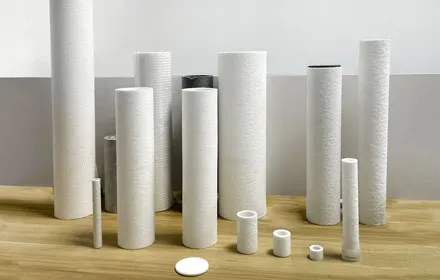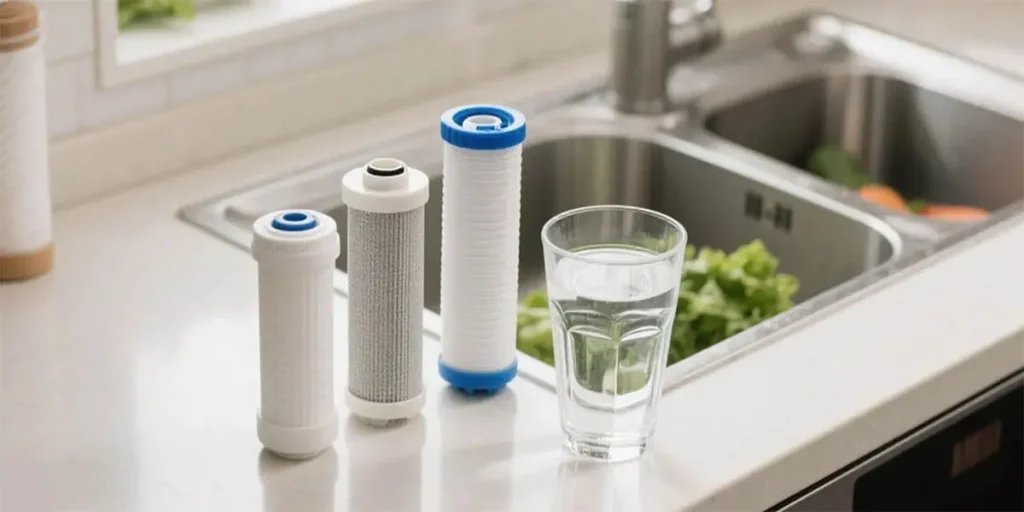
Water filter cartridges are modular filtration components designed to remove physical particles and chemical contaminants as water flows through specialized filter media. From a filtration system and manufacturing perspective, they are the most widely used solution for improving water quality because they balance performance, cost, and flexibility.
In actual water treatment applications, filter cartridges work by combining mechanical filtration and adsorption processes, allowing different contaminants to be addressed in a controlled and scalable way.
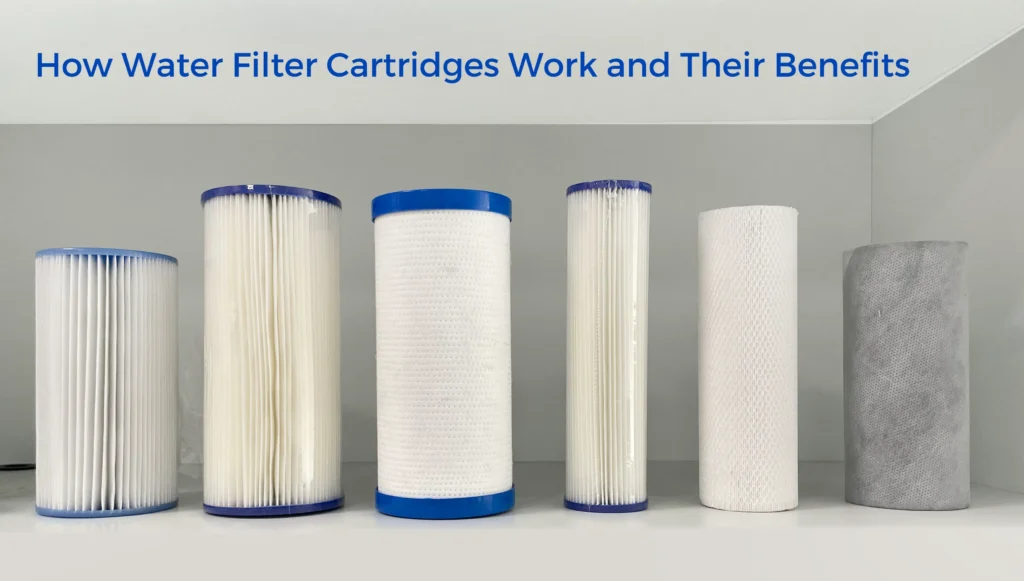
How Water Filter Cartridges Work
At their core, water filter cartridges function by forcing incoming water to pass through engineered filter media inside a sealed cartridge housing. As water moves through the cartridge, contaminants are removed based on particle size, surface interaction, and material properties.
From our experience in filter cartridge manufacturing, most cartridges rely on one or more of the following filtration mechanisms.
Core Filtration Mechanisms Explained
Mechanical Filtration: Trapping Suspended Particles
Mechanical filtration removes visible and invisible suspended solids such as sand, rust, silt, and pipe scale. using sediment filter cartridges used for particle removal. This function is commonly achieved using polypropylene (PP) filter media, including melt-blown and pleated structures.
Particles larger than the cartridge’s rated micron size are physically trapped within the fiber matrix. For example, a 5-micron PP sediment filter can capture fine particulates while maintaining stable flow under normal household water pressure.
In real-world systems, sediment filtration is usually positioned as the first stage to prevent premature clogging of carbon filters or membranes downstream.
Adsorption Filtration: Reducing Chemical Contaminants
Adsorption filtration targets dissolved contaminants such as chlorine, unpleasant odors, taste compounds, and certain organic chemicals. and it is commonly achieved using carbon-based filter media for chlorine reduction.
This process relies on activated carbon materials, including granular activated carbon, carbon block, and activated carbon fiber.
As water flows through the carbon media, contaminants adhere to the internal pore surfaces of the carbon structure. Materials like ACF are often used where fast adsorption and low pressure drop are required, due to their high surface area and uniform pore distribution.
From the perspective of manufacturing, adsorption efficiency is influenced not only by carbon type, but also by media density, contact time, and internal flow path design.
Depth Filtration vs Surface Filtration
Water filter cartridges can be categorized by how contaminants are captured within the media:
- Depth filtration traps particles throughout the thickness of the filter material. Melt-blown PP and carbon block cartridges are typical examples.
- Surface filtration captures contaminants primarily on the outer surface of the filter media, as seen in pleated filters and membrane-based cartridges.
In practice, depth filtration offers higher dirt-holding capacity, while surface filtration provides higher flow rates and easier cleaning.
Why Multi-Stage Filtration Is Commonly Used
In most residential and commercial water filtration systems, a single cartridge is rarely responsible for all purification tasks. Instead, multiple cartridges are arranged in stages, each addressing a specific category of contaminants.
A typical multi-stage configuration may include:
- A PP sediment filter cartridge for particulate removal
- A carbon-based filter cartridge for chlorine and organic contaminants
- An optional UF or RO membrane for advanced purification
This staged approach improves overall system stability and extends the service life of each cartridge.
Key Benefits of Water Filter Cartridges
Consistent Improvement in Water Quality
Filter cartridges significantly improve water clarity, taste, and odor by removing sediment and chemical contaminants. In many applications, this improvement is immediately noticeable, especially in municipally treated water where residual disinfectants are present.
Protection of Water Systems and Appliances
From an engineering perspective, sediment and particulate matter are among the main causes of pressure loss, valve wear, and membrane fouling. Properly selected filter cartridges help protect downstream equipment, reducing maintenance costs and system downtime.
Modular and Adaptable Design
One of the main advantages of the water purification filter element is its standardized size. The common sizes of 10” and 20” make it possible for system designers and end users to adjust the filtration performance simply by changing the type of filter element, without the need to modifying the entire system.
This modular design is the key reason why the filter element holds a dominant position in whole-house water purification systems, under-sink water purification systems, and commercial systems.
Cost-Effective Long-Term Solution
Compared with integrated filtration devices, the cartridge-type filtration system has a lower overall cost. Replacing the filter cartridge is much more economical than replacing the entire filtration component, especially in multi-stage systems.
Straightforward Maintenance and Replacement
Most water filter elements are designed to be replaced without tools or with just a few tools. Regular replacement of the filter elements helps maintain stable filtration performance and reduces the risk of contaminants breakthrough.
Common Applications of Water Filter Cartridges
Water filter cartridges are widely used in:
- Whole house water filtration systems
- Under-sink and countertop filtration units
- Faucet and refrigerator water filters
- RO and UF system pre-filtration
- Commercial and food service water treatment
Their versatility allows them to be used in both point-of-use and point-of-entry applications.
Choosing the Right Water Filter Cartridge
Selecting the right cartridge depends on source water quality, target contaminants, flow rate requirements, and system compatibility. From a manufacturer’s perspective, micron rating, filter material, and cartridge structure should be evaluated together rather than in isolation.
In most cases, combining sediment and carbon-based cartridges provides balanced performance for typical household water conditions.
Summary: How Water Filter Cartridges Work and Why They Matter
The working principle of the filter element is that when water flows through the specially designed filtering medium, the filter element physically traps particulate matter and adsorbs chemical pollutants. Its modular structure, adjustable performance and cost-effectiveness make it a fundamental component of modern water purification systems.
By understanding how these cartridges function and the benefits they provide, system designers and end users can make informed decisions, thereby obtaining safer, better-tasting, and more reliable water supply.