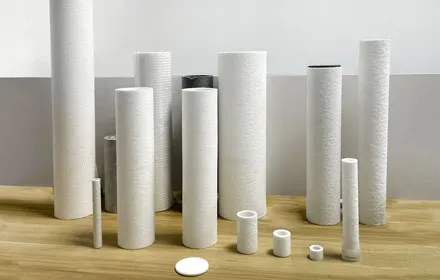
Multimedia Filter vs. Cartridge Filter — What Is the Difference?
Multimedia filters and cartridge filters play different roles in water treatment systems. Multimedia filters are mainly used for high flow rates and removing large amounts of sediment, employing multiple layers of loose media, while cartridge filters use replaceable filter elements to provide precise and stable filtration in compact systems.
For system designers, OEM manufacturers and water treatment equipment dealers, understanding the differences between multi-media filters and cartridge filters is crucial for choosing the appropriate filtration stage.
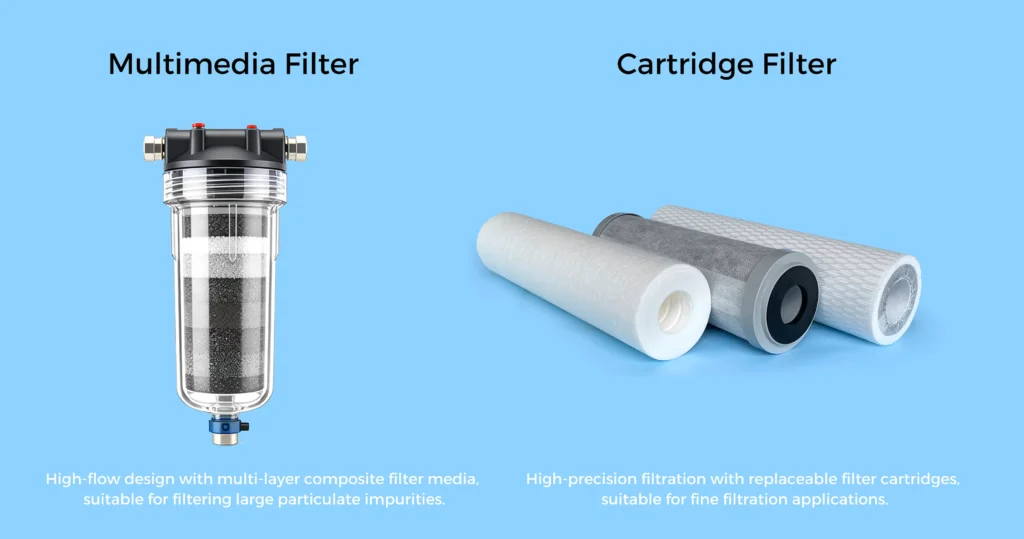
What Is a Multimedia Filter?
A multimedia filter is a tank-based filtration system filled with multiple layers of granular filter media. The media are arranged from coarse to fine to improve depth filtration efficiency.
Typical Media Used in Multimedia Filters
- Anthracite
- Silica sand
- Garnet or other dense mineral media
How a Multimedia Filter Works
Water flows downward through the media bed. Larger particles are captured in the upper layers, while finer particles are trapped deeper in the bed. Over time, accumulated sediment is removed through backwashing, which cleans and reclassifies the media layers.
Key Features
- Designed for high flow rates
- Effective for turbidity and suspended solids removal
- Long service life with proper backwashing
- Requires space, drain connections, and control valves
Multimedia filters are commonly used as pretreatment systems in industrial, commercial, and municipal water treatment projects.
What Is a Cartridge Filter?
A cartridge filter uses a replaceable filter cartridge installed inside a pressure housing. Filtration performance depends on the cartridge’s material, structure, and micron rating.
Common Cartridge Filter Types
- PP sediment filter cartridges (melt-blown or pleated)
- Activated carbon cartridges
- GAC or ACF filter cartridges
- UF or specialty functional cartridges
How a Cartridge Filter Works
Water passes through the cartridge media, which physically traps particles or adsorbs contaminants. Once the cartridge reaches its dirt-holding or adsorption limit, it is replaced, not cleaned.
Key Features
- Compact and modular design
- Precise and stable filtration accuracy
- No backwashing required
- Easy installation and maintenance
Cartridge filters are widely used in residential, commercial, and OEM water filtration systems.
Multimedia Filter vs. Cartridge Filter: Side-by-Side Comparison
| Feature | Multimedia Filter | Cartridge Filter |
| System Type | Media-filled tank | Housing + replaceable cartridge |
| Filtration Method | Depth filtration (loose media) | Depth or surface filtration |
| Typical Micron Range | 10–100 µm | 0.1–50 µm (depends on cartridge) |
| Maintenance | Backwashing | Cartridge replacement |
| Footprint | Large | Compact |
| Flow Capacity | High | Low to medium |
| Common Use | Industrial pretreatment | POU / POE / OEM systems |
When to Use a Multimedia Filter
A multimedia filter is the better choice when:
- Raw water contains high levels of sediment or turbidity
- High flow rates are required
- Backwashing infrastructure is available
- The system is used as pretreatment for RO, UF, or cartridge filters
From a system design perspective, multimedia filters protect downstream components by removing bulk solids efficiently.
When to Use a Cartridge Filter
A cartridge filter is more suitable when:
- Precise filtration accuracy is required
- Space is limited
- Stable outlet water quality is critical
- Maintenance simplicity is a priority
Cartridge filters are especially effective for fine sediment removal, chlorine reduction, taste and odor improvement, and functional contaminant removal, depending on the cartridge media used.
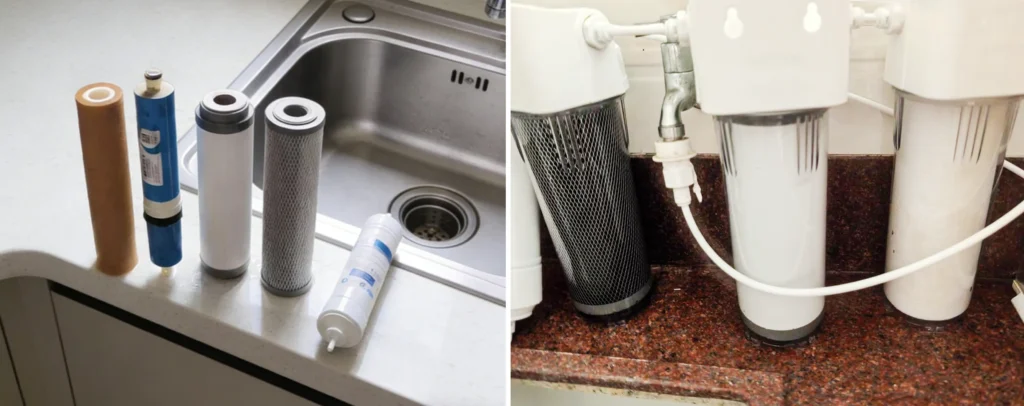
Multimedia Filter vs. Cartridge Filter in Practical System Design
In many professional water treatment systems, multimedia filters and cartridge filters are used together, not as direct replacements.
A typical configuration is:
Multimedia Filter → Cartridge Filter → Carbon / ACF Filter → RO or UF System
This layered approach:
- Extends cartridge service life
- Improves overall system stability
- Reduces operating costs
Cost and Maintenance Considerations
- Multimedia filters have higher initial investment and installation complexity but lower long-term media costs.
- Cartridge filters offer lower upfront cost and simpler operation, with predictable replacement cycles.
The optimal choice depends on water quality, system scale, maintenance strategy, and performance requirements.
Water filter manufacturer’s Perspective: Choosing the Right Filtration Stage
From a water filter cartridge manufacturing perspective, multimedia filters are not competitors to cartridge filters—they are complementary technologies.
- Multimedia filters handle bulk solids
- Cartridge filters deliver precision and consistency
Selecting the correct combination ensures system reliability and long-term performance.
Conclusion: Multimedia Filter vs. Cartridge Filter
The key difference between a multimedia filter vs. cartridge filter lies in scale, precision, and maintenance method. Multimedia filters are ideal for high-flow sediment pretreatment, while cartridge filters are essential for compact systems requiring accurate filtration.
For most modern water treatment applications, combining both technologies provides the best balance between performance and cost efficiency.