At first glance, a Pleated Filter Cartridge vs Melt Blown Filter Cartridge comparison seems straightforward. Both are used for particle and sediment filtration, so it is easy to assume that one is simply a better version of the other.
That is not how filter cartridges are normally designed. Pleated and melt blown cartridges solve slightly different filtration problems. The choice is usually made based on the amount and type of sediment, required flow, available space, replacement cost, and how the cartridge will be used in the system.

The Real Difference Is the Filter Structure
A melt blown cartridge is built from polypropylene fibers. During manufacturing, the fibers are formed into a three-dimensional porous structure. Water travels through the depth of this structure, and particles are captured along the way.
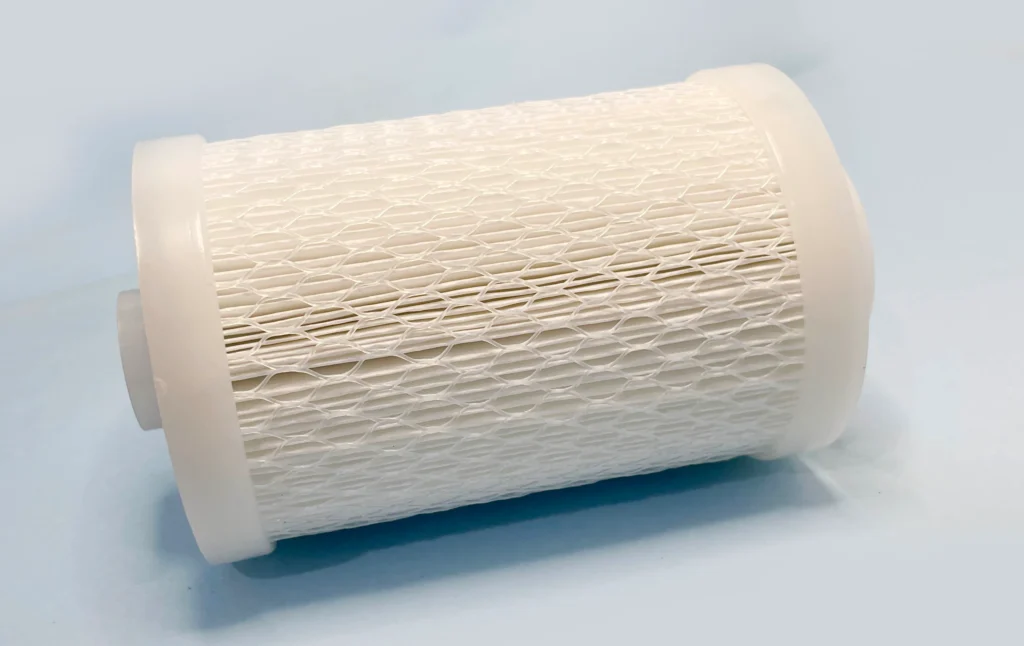
A pleated cartridge starts with a sheet of filter media. The media is folded repeatedly to increase the available filtration area without making the cartridge much larger.
This difference in construction is the starting point for understanding the two designs. A melt blown cartridge uses depth to provide filtration capacity. A pleated cartridge uses surface area to provide filtration capacity.
Why Would a Manufacturer Choose Melt Blown?
Consider water containing a large amount of sand, rust, silt, or other suspended particles. If the filter is expected to collect a substantial amount of sediment, depth filtration can be useful because particles can be distributed through the thickness of the media.
This is one reason PP melt blown cartridges are widely used as pre-filters. They are relatively simple, economical, and can be replaced when the pressure drop becomes too high. For many standard water filtration applications, there is no reason to use a more complicated cartridge when a melt blown cartridge can handle the job.
Why Would a Manufacturer Choose Pleated?
The situation changes when the system needs more filtration area within a limited cartridge size. Folding the media creates a large effective surface area. This allows the cartridge to process water through a much larger area than a flat sheet of the same dimensions.
That can be useful when the application requires higher flow or wants to keep pressure drop under control.
Pleated construction also allows manufacturers to use different types of media. Depending on the application, a pleated cartridge can be made from polypropylene, polyester, membrane materials, and other filter media.
So pleated filtration is not one specific filtration technology. It is a cartridge design that can be combined with different media.
What Happens When the Water Has a Lot of Sediment?
This is where the difference becomes more practical. Imagine two systems with the same cartridge size and the same nominal micron rating. One receives relatively clean water with occasional fine particles. The other receives water with a high concentration of sediment.
The second application puts much more loading pressure on the filter. A melt blown cartridge can be useful here because its depth structure provides space for particles to accumulate inside the media. A pleated cartridge may still work well, particularly when it has a large filtration area, but the result depends strongly on the media and pleat design.
This is why choosing a cartridge based only on its micron rating can lead to disappointing results.
Does a Pleated Cartridge Always Have a Higher Flow Rate?
Not necessarily. Pleated cartridges have the potential for high flow because of their large filtration area, but flow is affected by much more than cartridge structure.
Media permeability, micron rating, cartridge length and diameter, pleat configuration, water viscosity, and the amount of contamination all affect the actual flow rate.
The same principle applies to melt blown cartridges. Changing fiber density and cartridge dimensions can significantly change their flow performance. For an OEM application, the better question is not “Which type has higher flow?” but rather:
What flow rate does the cartridge need to deliver at an acceptable pressure drop? That gives the manufacturer a useful design target.
What About Cartridge Cost?
Melt blown cartridges usually have an advantage when low unit cost is important. A melt blown cartridge is formed directly from PP fibers during the melt-blowing process.
A pleated cartridge requires additional steps such as media cutting, pleating, sealing, and end-cap assembly. Some designs also require inner and outer support cores. If a pleated cartridge lasts significantly longer or allows the system to operate at a higher flow rate, its cost per unit of treated water may be competitive.
For commercial buyers, cost per cartridge is therefore less useful than cost over the cartridge’s actual service life.
The Application Should Come Before the Cartridge Type
A common mistake in cartridge selection is starting with the question: “Should I use pleated or melt blown?”
A better starting point is:
What does the cartridge need to remove, and what does the filtration system require?
For example, a sediment pre-filter may prioritize low cost and good dirt loading. A high-flow filtration stage may place more importance on filtration area and pressure drop.
Cartridge dimensions matter as well. A 10-inch cartridge operating at a relatively low flow has very different design requirements from a large commercial cartridge processing a much higher volume of water.
The same filter structure cannot be expected to perform optimally in every application.
Pleated Filter Cartridge vs Melt Blown Filter Cartridge: A Design Decision
The Pleated Filter Cartridge vs Melt Blown Filter Cartridge question is therefore better understood as a design decision rather than a simple product comparison.
Melt blown construction is often chosen for economical depth filtration and sediment loading. Pleated construction is useful when a large filtration area, higher flow capability, or a specific filter media is required.
Neither design is automatically better.
For filter cartridge manufacturers, the important part is matching the media and cartridge structure to the actual operating conditions. Water quality, flow rate, pressure, micron rating, cartridge size, and expected service life should all be considered before deciding on the final design.
Damai Tech manufactures both PP melt blown and pleated filter cartridges and can adjust cartridge dimensions, filtration ratings, media structure, and connections according to different filtration requirements.