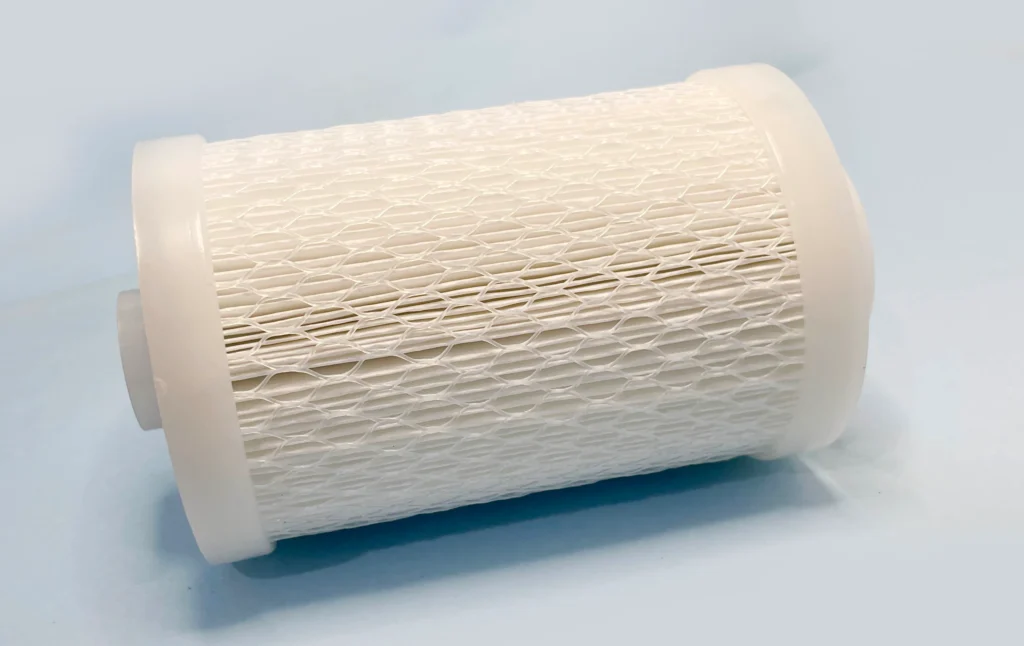
A T33 water filter is an inline post-carbon filter commonly used as the final filtration stage in household reverse osmosis (RO) water purifiers. It is installed after the RO membrane and before the drinking water faucet.
Most T33 filters use granular activated carbon, often coconut shell activated carbon, to improve the taste and odor of purified water.

What Is a T33 Water Filter?
A T33 is essentially an inline post-carbon filter. Unlike conventional cartridges that require a separate filter housing, an inline T33 usually has its own plastic housing and connects directly to the water tubing.
A common household design uses a food-grade PP housing with quick-connect fittings. The exact dimensions, connection size, carbon type, and carbon filling weight vary between manufacturers.
The typical installation is: RO Membrane → T33 Post Carbon Filter → Faucet
Its main function is final water polishing rather than primary purification.
What Does T33 Mean?
T33 is a product or model designation, not a filtration rating. It doesn’t mean 33 microns, 33 cm, or 33 inches. The term has become widely used in the water filtration industry for a type of inline post-carbon filter. Because T33 is not a universal technical standard, products sold as T33 filters can have different dimensions and specifications, this is also why the market has terms such as small T33 and big T33.
How Does a T33 Filter Work?
They mainly work through activated carbon adsorption. After water passes through the RO membrane, it enters the T33 filter. The activated carbon can adsorb residual chlorine, certain organic compounds, and substances that affect taste and odor.
The result is mainly an improvement in the taste, smell, and overall drinking experience of RO-treated water. A standard T33 does not normally reduce TDS. TDS reduction is primarily performed by the RO membrane.
T33 vs UDF Carbon Filter
Both T33 and UDF filters commonly use granular activated carbon, but they have different positions and purposes.
| UDF Carbon Filter | T33 Post Carbon Filter | |
| Position | Before RO membrane | After RO membrane |
| Main purpose | Pre-treatment and membrane protection | Taste and odor improvement |
| Typical media | Granular activated carbon | Granular activated carbon |
| TDS reduction | No | No |
The key difference is their position in the RO system.
A typical system may therefore be: PP Sediment → UDF Carbon → RO Membrane → T33 → Faucet
Small T33 vs Big T33
Small T33 is the most common version for household RO water purifiers. It is compact and typically uses quick-connect fittings for direct installation in the water line. A common small T33 may have a diameter of around 50 mm, but dimensions are not universally standardized.
Big T33 has a larger housing and usually contains more activated carbon. It can provide higher flow and greater carbon capacity and is more commonly used in larger or commercial water purification systems.
| Feature | Small T33 | Big T33 |
| Size | Compact | Larger |
| Carbon capacity | Lower | Higher |
| Flow capacity | Lower | Higher |
| Typical use | Household RO | Commercial/larger systems |
The terms “small T33” and “big T33” are industry names rather than strict international standards, so actual dimensions should always be confirmed.
Common T33 Water Filter Specifications
A typical household T33 may have the following configuration:
- Type: Inline post-carbon filter
- Application: Household RO water purifier
- Media: Granular activated carbon
- Common carbon: Coconut shell activated carbon
- Housing: Food-grade PP
- Connection: Quick-connect fittings
- Installation: After RO membrane
For OEM projects, the dimensions, carbon filling weight, connection type, flow rate, and packaging can be customized according to the water purifier design.
How Long Does a T33 Filter Last?
It’s commonly replaced every 6–12 months, depending on water consumption, source-water quality, carbon capacity, and operating conditions.
After installing a new carbon filter, some carbon fines may initially appear in the water. The filter should be flushed according to the manufacturer’s instructions until the water runs clear.
T33 Water Filter for OEM Manufacturing
For water purifier manufacturers, distributors, and private-label brands, T33 filters can be customized to match specific system requirements. Common OEM options include filter dimensions, activated carbon type, carbon filling weight, connection size, flow rate, housing, labeling, and packaging.
For B2B purchasing, it is better to specify these technical requirements rather than simply asking for a “T33 filter,” because T33 is not a single standardized specification.
Conclusion
A T33 water filter is a common inline post-carbon filter used after the RO membrane. Its primary purpose is to improve the taste and odor of purified water through activated carbon adsorption.
Small and big T33 filters mainly differ in size and carbon capacity. Since T33 is an industry product name rather than a universal specification, buyers should confirm the actual dimensions, carbon type, filling weight, connections, and performance requirements when selecting or developing a T33 filter.