Water filtration has no shortage of new technologies.
Membranes are becoming more efficient. Ion exchange resins are used for increasingly specific contaminants. New adsorbent materials are being developed for PFAS, pharmaceuticals, and other emerging pollutants.
Yet walk into almost any water filtration market and you will still find activated carbon.
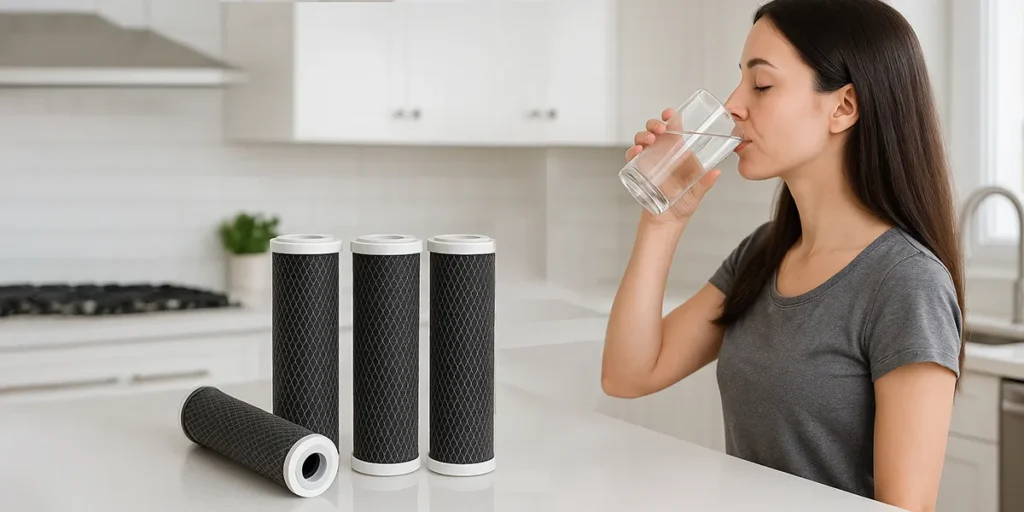
It’s in household drinking water filters, commercial filtration systems, RO pretreatment, faucet cartridges, shower filters, and industrial water treatment.
That raises an interesting question: if filtration technology has advanced so much, why is activated carbon still everywhere?
The answer isn’t that activated carbon is the most advanced filtration material available. In many cases, it isn’t.
Its strength is something more practical: it offers a very good balance between performance, cost, flexibility, and manufacturing maturity.
Filtration Is Not Always About Using the Most Advanced Technology
One common misunderstanding in water filtration is that newer technology automatically means better technology.
But a filter is not designed simply to remove as many contaminants as possible. It has to meet a particular application.
A household faucet filter, for example, may primarily need to reduce chlorine, improve taste and odor, and remove certain organic compounds. Using a high-pressure membrane system for such an application could make the product unnecessarily complicated and expensive.
This is where activated carbon becomes attractive.
It can target contaminants that mechanical filters cannot remove while operating without the high pressure required by technologies such as RO.
In other words, activated carbon fills an important gap between simple particle filtration and more complex purification technologies.
Activated Carbon Has a Very Flexible Role
Another reason for its continued popularity is that activated carbon is not tied to one particular type of filtration system.
It can be used as a loose granular medium, incorporated into carbon blocks, combined with other filtration materials, or formed into specialized structures such as activated carbon fiber.
This flexibility allows manufacturers to adapt carbon filtration to very different products.
A large commercial system may use a deep carbon bed, while a compact faucet filter may use only a relatively small carbon-containing cartridge.
The filtration principle remains adsorption, but the engineering around the carbon can be completely different.
That makes activated carbon less of a single product and more of a platform material for different filter designs.
The Cost-to-Performance Balance Is Hard to Ignore
Performance matters, but so does cost.
A water filter cartridge has to be manufactured, transported, installed, replaced, and eventually disposed of. For commercial products, even a small increase in material or manufacturing cost can become significant at high volumes.
Activated carbon benefits from a mature global supply chain and many commercially available grades. Manufacturers can select different carbon sources, particle sizes, pore structures, and forms depending on the application. This gives product designers considerable room to balance adsorption performance against cartridge size and cost.
That flexibility is one reason activated carbon continues to make economic sense even when newer filtration materials are available.

Activated Carbon Also Works Well in Multi-Stage Filtration
Another reason activated carbon remains important is that modern filtration systems rarely depend on a single filter material.
Different cartridges can perform different jobs.
A sediment filter can remove suspended particles and protect downstream media. Activated carbon can then handle chlorine, taste, odor, and various organic compounds. A membrane can provide further reduction of dissolved contaminants.
This division of labor is often more practical than asking one material to do everything.
For example, in an RO system, carbon filtration is commonly used before the membrane. In this case, the value of activated carbon is not replacing RO. It is helping the overall system work properly.
This is an important distinction when evaluating filtration materials.
A material does not need to remove every contaminant to be valuable. It only needs to perform its specific role effectively.
The Form of Carbon Is Changing
The future of activated carbon filtration is also not necessarily about using traditional GAC in exactly the same way it has been used for decades.
The industry has continued to develop different carbon structures and cartridge designs.
Carbon blocks provide a compact structure with mechanical filtration combined with adsorption. Composite filter cartridges can combine carbon with sediment filtration. Activated carbon fiber provides another approach, using a fibrous structure rather than conventional carbon granules.
This development is significant because it shows that activated carbon itself is not an outdated technology.
The material can evolve as cartridge designs evolve.
For compact point-of-use products, for example, the challenge may not simply be how much carbon can be put into a cartridge. It may be how effectively water can contact the available carbon while maintaining an acceptable flow rate and pressure drop.
That shifts the focus from simply choosing a filtration material to engineering the entire cartridge.
Why Activated Carbon Is Difficult to Replace
Could another material eventually replace activated carbon?
For individual applications, absolutely. If the target is hardness, ion exchange may be more appropriate. If the target is dissolved salts, RO may be the better choice. If the primary concern is bacteria or viruses, membrane technologies or disinfection processes may be more suitable.
But replacing activated carbon across the entire water filtration industry is a much bigger challenge.
A replacement material would need to offer comparable adsorption performance, availability, scalability, cost, processing options, and compatibility with existing filtration systems. That is a much higher standard.
This is why activated carbon continues to coexist with newer technologies rather than simply being replaced by them.
The Real Innovation May Be in the Cartridge, Not the Material
For filter cartridge manufacturers, this is perhaps the most important point.
The question is no longer simply: “Is activated carbon a good filtration material?”
The more useful questions are:
- How much carbon is required?
- What type of carbon should be used?
- What contaminant is being targeted?
- What is the expected flow rate?
- How much contact time is available?
- How should the carbon be structured inside the cartridge?
- Can the cartridge maintain performance throughout its service life?
These questions determine whether the final filter actually performs well.
This is also where materials such as activated carbon fiber become interesting. The underlying adsorption principle is familiar, but changing the physical structure of the carbon creates new possibilities for cartridge design.
Activated Carbon Is Not the Old Technology Some People Think It Is
Activated carbon has been used in water treatment for a long time, but longevity should not be confused with obsolescence.
Some technologies disappear when something better comes along. Others survive because they remain useful.
Activated carbon belongs to the second category.
Its continued importance comes from a combination of practical advantages: adsorption capability, flexibility, relatively straightforward integration into filtration systems, and the ability to work alongside other technologies.
The future of water filtration is therefore unlikely to be activated carbon versus new technology.
It is more likely to be activated carbon together with membranes, sediment filtration, ion exchange, and newer adsorbent materials.
And as filter cartridges become smaller, more specialized, and more application-specific, the way activated carbon is structured and used may become just as important as the carbon itself. That is why activated carbon remains one of the most important filtration materials—not because it is the newest technology, but because it continues to solve real filtration problems in a practical way.