Dirt holding capacity (DHC) is the amount of particulate contamination a water filter cartridge can retain before reaching a specified terminal pressure drop under defined test conditions.
In simple terms, it tells you how much dirt a filter cartridge can hold before it needs to be replaced or serviced.
A higher dirt holding capacity can provide a longer service interval under the same operating conditions. However, DHC should not be confused with filtration precision.
Micron rating determines how small a particle the filter is designed to remove, while dirt holding capacity indicates how much contamination the filter can retain.
How Does Dirt Holding Capacity Work?
As water passes through a filter cartridge, contaminants such as sand, rust, silt, and suspended solids become trapped in the filter media.
As more particles accumulate, resistance to water flow increases. This causes the differential pressure between the inlet and outlet of the cartridge to rise.
When the differential pressure reaches the specified terminal pressure drop, the cartridge has reached the end point of the DHC test.
This is why dirt holding capacity is normally expressed as a weight of retained contaminant, such as grams.
What Affects Dirt Holding Capacity?
DHC depends on more than the filter’s micron rating. Several factors can affect how much contamination a cartridge can retain.
Filter Media Structure
Depth filtration can distribute contaminants throughout the thickness of the media, allowing the available filter volume to be used more effectively.
For example, PP melt-blown filter cartridges can use gradient-density structures to capture larger particles in the outer layers and smaller particles deeper inside the media.
Pleated cartridges take a different approach. Their large filtration area provides more surface area for contaminant loading and can support high flow rates.
Micron Rating
A finer micron rating does not automatically mean higher dirt holding capacity.
Under comparable conditions, a 1-micron PP cartridge may load faster than a 5-micron cartridge because it retains smaller particles. However, the actual DHC still depends on media structure, filtration area, flow rate, and test conditions.
Therefore, choosing the finest available filter is not always the best solution.
Incoming Water Quality
Water quality has a major impact on actual cartridge life.
High levels of sediment, rust, silt, or suspended solids can quickly consume the available dirt holding capacity. The same cartridge may therefore have very different service lives in different water sources.
Flow Rate
Flow rate also affects pressure drop and contaminant loading.
A cartridge operating at a higher flow rate may develop pressure drop more quickly than the same cartridge operating at a lower flow rate. For this reason, laboratory DHC results should not be treated as a guaranteed service life for every application.

Dirt Holding Capacity of Different Filter Types
Different filter technologies handle contaminants differently.
PP melt-blown cartridges are commonly used for sediment filtration. Their depth structure can provide good dirt holding capacity for sand, rust, silt, and suspended solids.
Pleated filter cartridges provide a large effective filtration area and are often selected when high flow and relatively low initial pressure drop are important.
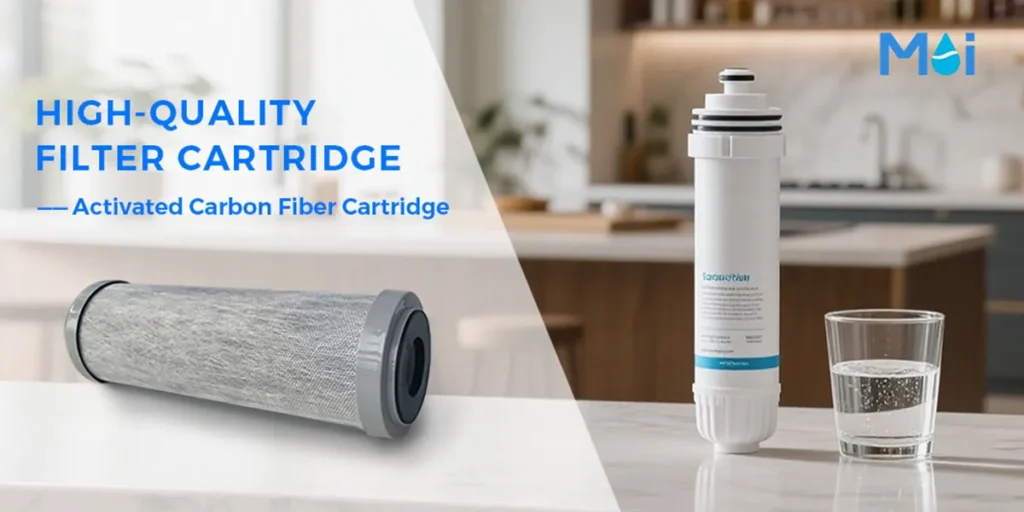
Activated carbon cartridges, including GAC, carbon block, and ACF cartridges, are primarily designed for adsorption of contaminants such as chlorine, taste, odor, and certain organic compounds. Their performance should therefore not be evaluated by particulate DHC alone. A sediment prefilter can help prevent excessive solid loading.
UF and RO membranes are generally not selected according to conventional dirt holding capacity. Particulate contamination and fouling should normally be controlled through appropriate pretreatment.
How Is DHC Tested?
Dirt holding capacity is measured under controlled test conditions.
A specified contaminant is introduced into water flowing through the cartridge. As the filter collects the contaminant, the differential pressure gradually increases.
When the cartridge reaches the specified terminal pressure drop, the amount of contaminant retained is measured. This becomes the reported DHC value for that test.
Because test conditions affect the result, DHC values should only be compared when the test methods, contaminant, flow rate, filter size, and terminal pressure conditions are comparable.
This is especially important when comparing cartridges from different manufacturers.
How Can You Choose the Right Filter Cartridge?
Dirt holding capacity should be considered together with other performance parameters.
When selecting a cartridge, evaluate:
- Micron rating – required particle removal size
- Dirt holding capacity – particulate loading capability
- Flow rate – required water throughput
- Pressure drop – acceptable resistance to flow
- Filter area and structure – available contaminant-loading capacity
- Incoming water quality – sediment and suspended-solid concentration
For water with a high sediment load, using a suitable prefiltration stage can protect finer downstream cartridges and extend overall system service life.
Conclusion
Dirt holding capacity tells you how much particulate contamination a water filter cartridge can retain before reaching a specified terminal pressure drop.
It is an important indicator of cartridge service life, but it should not be considered independently. A good filter design needs to balance DHC, micron rating, flow rate, pressure drop, filtration efficiency, and actual water quality.
For OEMs and water filtration system manufacturers, Damai provides customized PP melt-blown, PP pleated, ACF, and composite filter cartridges. Filter media, micron rating, dimensions, end-cap configuration, and other specifications can be customized according to application requirements.
Looking for a Custom Filter Cartridge Solution?