Why Chlorine Removal Looks Simple—but Isn’t
Chlorine is one of the easiest contaminants to remove on paper. Almost any carbon-based filter claims to reduce it.
But in real filtration systems—especially compact cartridges—the difference between Activated Carbon Fiber (ACF) and Granular Activated Carbon (GAC) becomes noticeable very quickly.
From a manufacturer’s perspective, chlorine removal is less about “can it be removed” and more about how fast, how consistently, and under what flow conditions.
When GAC Works Well—and When It Struggles
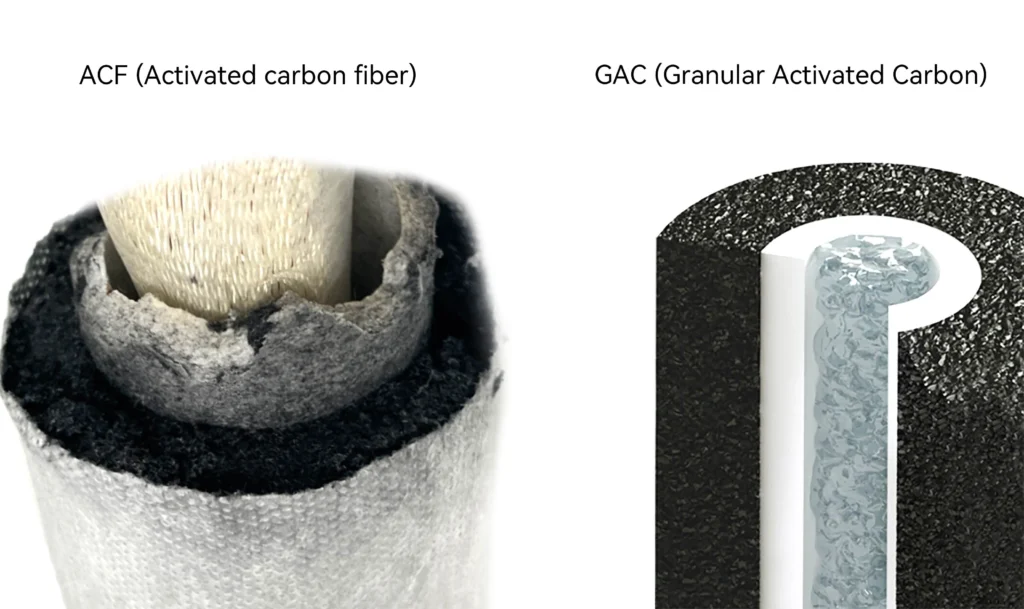
GAC has been used for decades, and for good reason. In large housings or whole house systems, a deep GAC bed provides plenty of contact time. Under these conditions, chlorine reduction is stable and predictable.
However, GAC relies on water slowly moving into the internal pore structure of each granule. That process takes time.
Once flow rate increases or cartridge size becomes smaller, chlorine removal efficiency can drop—not because GAC lacks adsorption capacity, but because the water simply doesn’t stay long enough.
This is one reason why GAC performs better in:
- Whole house systems
- Large carbon tanks
- Low-flow, high-bed-depth designs
Why ACF Behaves Differently in Compact Filters
ACF behaves differently because of its structure. Instead of granules, carbon is arranged in thin fibers with adsorption sites directly exposed to water.
In practical terms, this means:
- Chlorine molecules reach adsorption sites almost immediately
- Effective removal can occur even with short contact time
- Performance is less sensitive to cartridge size
This characteristic becomes important in applications like faucet filters, shower filters, or inline cartridges, where space is limited and flow rates are relatively high.
In these cases, activated carbon fiber filter cartridge often shows more stable chlorine reduction per unit volume compared to GAC.
Flow Rate Changes the Outcome More Than Material Labels
One common mistake is comparing ACF and GAC without considering flow conditions.
At very low flow rates, the performance gap narrows.
At higher flow rates, the difference becomes more obvious.
In compact systems:
- ACF tends to maintain chlorine reduction
- GAC performance depends heavily on bed depth and packing quality
This is why two filters using “activated carbon” can behave very differently in real use.
Pressure Drop and User Experience
Pressure drop is rarely discussed in chlorine-focused comparisons, but it affects real-world performance.
- ACF structures generally allow water to pass with lower resistance
- GAC beds may compact over time, increasing pressure loss
Lower pressure drop helps maintain consistent flow, which indirectly supports stable chlorine removal throughout the cartridge’s service life.
Service Life Isn’t Just About Carbon Weight
Another practical difference appears over time.
In GAC cartridges, uneven flow paths or channeling can reduce effective carbon utilization.
ACF, due to its layered fiber structure, tends to expose adsorption sites more evenly.
This often leads to more predictable chlorine reduction until replacement, especially in small-format cartridges.
Choosing Between ACF and GAC for Chlorine Removal
From an application standpoint:
- ACF is often preferred for compact, high-flow, point-of-use systems
- GAC remains effective in large systems with sufficient contact time
Neither material is universally better—the system design determines which performs better.
Final Perspective from a Filtration Manufacturer
When evaluating ACF vs GAC performance in chlorine removal, the key question is not which material removes chlorine in theory, but which material matches the operating conditions of the filter.
Flow rate, space limitations, and user expectations all matter.
Material selection should follow system design—not the other way around.