What Is an Activated Carbon Water Filter?
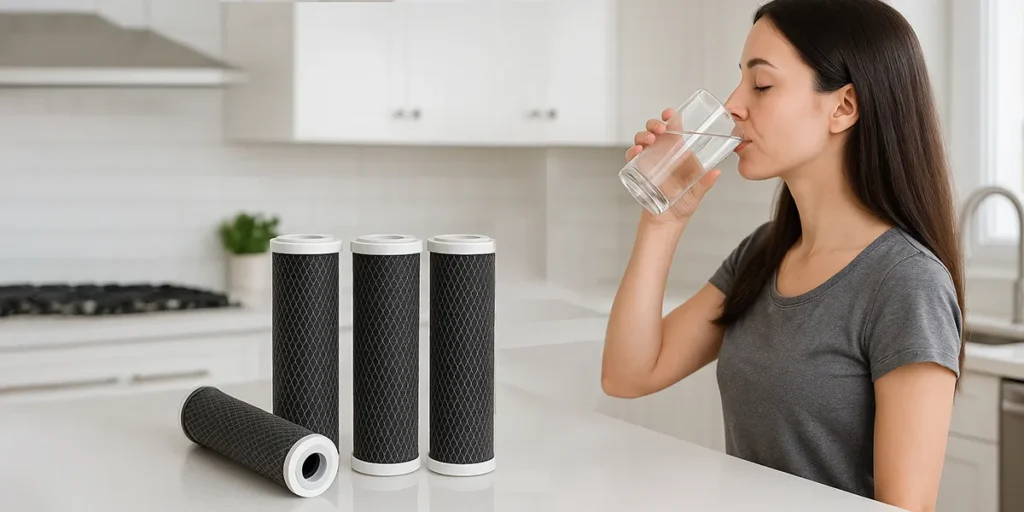
An activated carbon water filter is one of the most popular and effective filtration components used in residential and commercial water purification systems. It is designed to improve drinking water quality by removing unpleasant odors, residual chlorine, organic contaminants, discoloration, and certain chemical pollutants through a physical adsorption process.
Compared with sediment filters that only trap visible particles and RO membranes that block almost all substances, carbon water filters focus on water taste, smell, and chemical purification. For most households dealing with chlorinated tap water and bad odor, an activated carbon water filter is an indispensable part of a complete filtration system.
How Does an Activated Carbon Filter Work?
Activated carbon materials feature millions of microscopic pores on their surface. These micropores create an extremely large specific surface area, allowing the carbon material to capture harmful substances when tap water passes through the filter cartridge.
The whole filtration process contains two core mechanisms:
Physical Adsorption: Micropores trap odor molecules, chlorine compounds, volatile organic compounds, and tiny impurity particles.
Chemical Adsorption: Activated carbon reacts with residual chlorine to eliminate chlorine taste without damaging beneficial minerals in the water.
What Contaminants Can Carbon Water Filters Remove?
A high-quality activated carbon water filter can effectively eliminate the following common tap water issues:
- Residual chlorine and bleach odor
- Bad tastes, musty smells, and earthy odors
- VOC removal
- Organic pollutants, pesticides, and industrial chemical residues
- Yellowish discoloration caused by aging water pipes
- Partial heavy metal ions such as lead and mercury (varies by carbon material grade)
Limitations of Activated Carbon Filters
Although carbon filters excel at improving water taste, they cannot solve all water quality problems. Standard activated carbon filters are unable to filter fine sediment, bacteria, viruses, and dissolved inorganic salts. To achieve full-range purification, users usually combine carbon cartridges with PP sediment filters or RO membrane filters.
4 Main Types of Activated Carbon Water Filter Cartridges
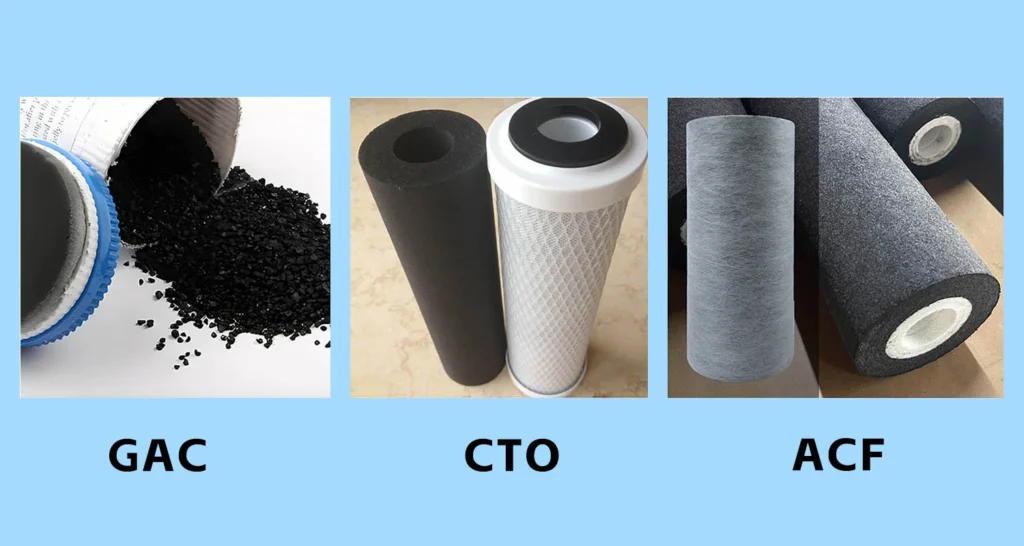
Not all carbon water filters perform the same. The performance gap between different carbon filter types is huge, especially in adsorption capacity, water flow rate, service life, and carbon shedding risk. Currently, there are four mainstream activated carbon cartridges available for water filtration: GAC, CTO, PAC, and ACF.
GAC (Granular Activated Carbon)
GAC filter cartridges are filled with loose granular activated carbon, which is the most affordable and widely used carbon filter type on the market.
Pros: Low cost, fast water flow, easy to produce and replace.
Cons: Uneven water flow channeling, unstable adsorption effect, easy to drop carbon powder, relatively short service life.
Best for: Budget users and simple pre-filtration for basic odor removal.
CTO (Carbon Block Filter)
CTO filters compress granular carbon into an integrated solid carbon block. This design solves the channeling problem of loose GAC carbon and improves overall filtration stability.
Pros: Higher filtration accuracy than GAC, better impurity interception ability, fewer carbon shedding issues.
Cons: Higher water pressure drop, slower water flow, and easy to clog in poor water quality areas.
Best for: Mid-range household under-sink water filter systems.
PAC (Powdered Activated Carbon)
PAC adopts ultra-fine powdered activated carbon material. It features ultra-high instant adsorption speed and is mostly used for temporary water treatment and industrial sewage purification instead of daily household drinking water.
Pros: Fast adsorption speed for sudden odor problems.
Cons: Severe carbon shedding, difficult to fix inside filter housing, not suitable for long-term daily use.
ACF (Activated Carbon Fiber Filter) — Advanced Carbon Solution
ACF filter is the upgraded version of traditional activated carbon filters, regarded as the next-generation carbon filtration material for high-end drinking water systems. Different from traditional particle-based carbon, ACF takes fibrous activated carbon as the core raw material, forming a three-dimensional micropore structure.
Pros:
- 5~10 times larger specific surface area than ordinary carbon filters
- Stronger adsorption performance for stubborn odor and residual chlorine
- High water permeability with negligible pressure drop
- Longer service life (30%~60% longer than GAC/CTO)
- Integrated fiber structure, zero carbon shedding
Best for: Users who pursue premium drinking taste, families with infants, and commercial high-flow water dispensers.
ACF VS GAC VS CTO: Side-by-Side Comparison
To help users quickly distinguish which activated carbon water filter fits their demands, we compared the four core indicators of mainstream carbon filter cartridges:
Adsorption Capacity & Micropore Structure
GAC and CTO rely on discrete carbon particles for adsorption, and most micropores are wrapped inside particles, unable to fully contact water. ACF’s open fiber structure exposes almost all micropores directly to the water flow, maximizing the utilization rate of activated carbon materials. In terms of chlorine and odor removal efficiency, ACF outperforms traditional carbon filters significantly.
Water Flow Speed & Pressure Drop
Many household users abandon carbon block filters due to low water pressure. Compressed CTO filters greatly reduce water flow speed; loose GAC filters ensure flow but sacrifice stability. As a fibrous filter material, ACF maintains high flow rate without causing obvious pressure drop, perfectly balancing filtration performance and water output.
Service Life & Replacement Frequency
GAC cartridges usually need replacement within 3~6 months; CTO cartridges can last 6~8 months. Premium ACF filter cartridges can maintain stable filtration performance for 8~12 months under the same water quality conditions, effectively reducing long-term replacement costs for users.
Carbon Shedding Risk & Water Taste
Black water caused by carbon powder shedding is a common complaint of GAC and low-quality CTO filters. ACF’s integral fiber structure completely avoids carbon shedding problems. Meanwhile, ACF can effectively remove musty, earthy and chlorine odor, providing cleaner and sweeter-tasting drinking water.
Common Applications
Under-Sink Water Filtration Systems
Under-sink purification systems are the largest usage scenario for carbon filter cartridges. Most users choose PP sediment filter + ACF carbon filter + RO membrane combination to obtain healthy and great-tasting drinking water.
Countertop Water Dispensers & Water Coolers
Desktop water dispensers and commercial water coolers require high-flow and zero-carbon-shedding filter cartridges, making ACF the most suitable upgrade option to replace original factory GAC cartridges.
Commercial Drinking Water Filtration
Cafés, milk tea shops, offices, and factories have high daily water consumption. 20-inch high-flow ACF filter cartridges can meet large-volume water supply requirements while keeping excellent water taste.
How to Choose the Right Activated Carbon Water Filter
Judge According to Local Water Quality
- Light water quality: Ordinary GAC filter is sufficient for basic chlorine removal.
- High chlorine & odor water: Upgrade directly to ACF filter for thorough odor elimination.
- Poor rural/old community water: Match PP sediment filter with ACF carbon filter for dual purification.
Match Filter Size & Interface
Activated carbon water filters are mainly divided into 10-inch and 20-inch standard sizes, with flat end, quick-connect, and threaded interfaces. Before purchasing, users must confirm the size and interface type of their filter housing to avoid compatibility problems.
Budget & Long-Term Cost Suggestion
Although the unit price of ACF filter cartridges is slightly higher than traditional GAC and CTO filters, its longer service life reduces replacement frequency. For long-term household use, upgrading to an ACF activated carbon water filter is more cost-effective and user-friendly.
Final Summary
Activated carbon water filters are essential accessories for modern water purification equipment, capable of solving tap water’s chlorine taste, peculiar odor and discoloration problems. Among GAC, CTO, PAC and ACF four mainstream types, traditional particle carbon filters are suitable for low-budget basic filtration, while ACF activated carbon fiber filters represent the highest level of current civilian carbon filtration technology.
If you are tired of frequent filter replacement, black water caused by carbon shedding, and poor-tasting tap water, upgrading your ordinary carbon cartridge to a high-quality ACF filter is the most efficient solution for home and commercial water filtration.