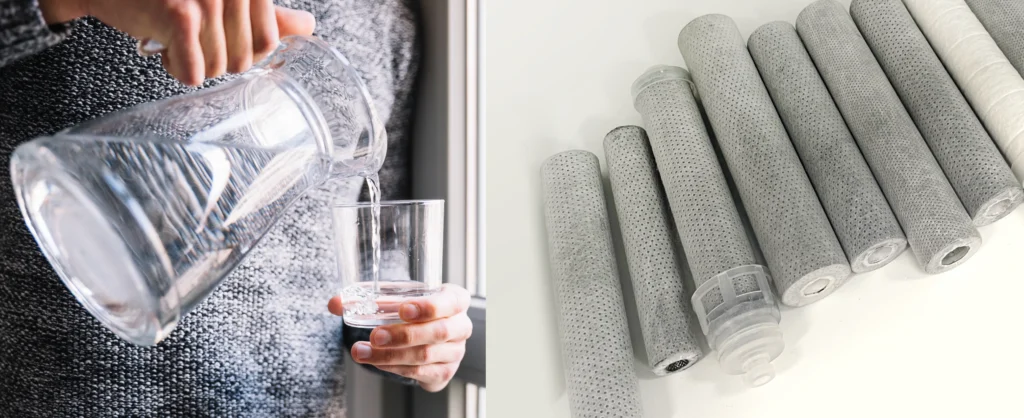
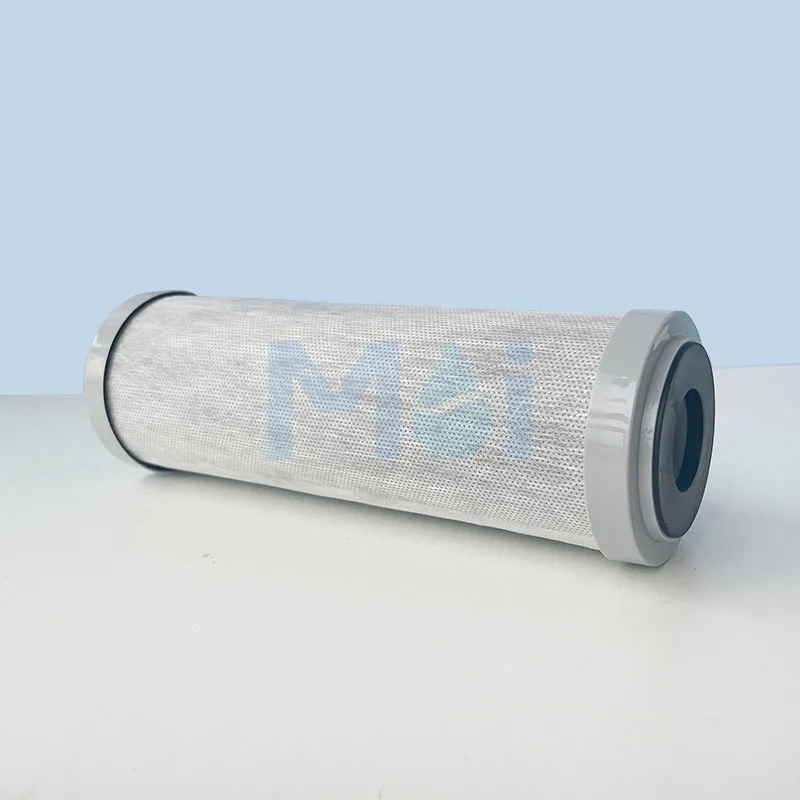
Clean and safe drinking water is an indispensable part of modern healthy life. As tap water often contains heavy metals, residual chlorine, sediments, organic contaminants and other harmful substances, more and more families are equipped with water filters to obtain drinkable water directly. However, many consumers are confused about why two water filters with similar appearances can deliver completely different water purification results and service life. If you want to pick a high-performance and cost-effective water purification system, you need to know the core factors that affect the effectiveness of a water filter.
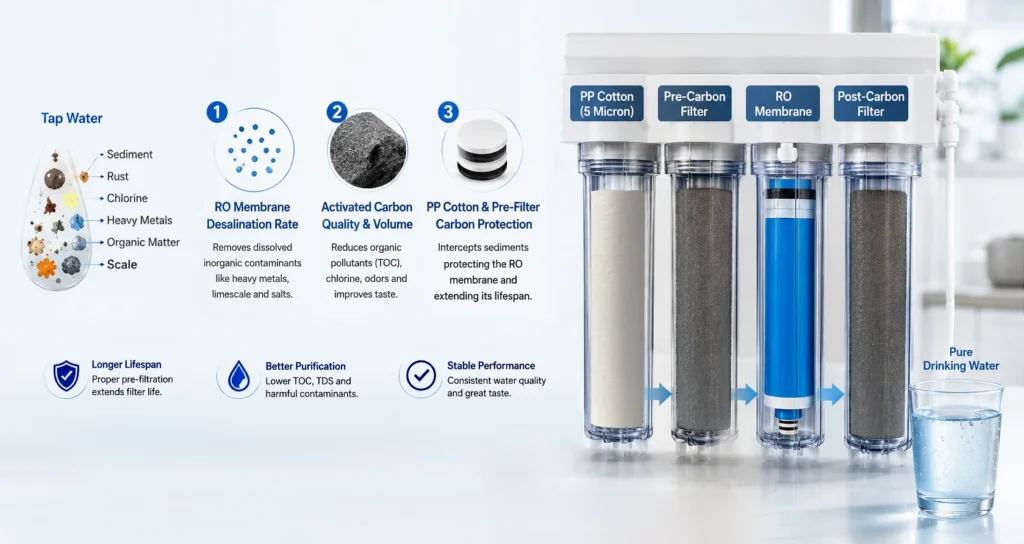
RO Membrane Desalination Rate (Core Factor for Inorganic Filtration)
For RO water filters, the RO membrane serves as the core filtration component of the whole system, and its desalination rate is one of the most critical indicators to judge filtration performance. The primary strength of an RO membrane is removing dissolved inorganic contaminants from tap water, including heavy metal ions, limescale-causing calcium and magnesium ions, and various soluble inorganic salts.
It is worth clarifying a common misconception: an RO membrane cannot eliminate every type of water contaminant. It performs outstandingly against dissolved solids and inorganic pollutants, yet it has limited removal efficiency for certain small-molecule organic compounds, which is why auxiliary filter stages are essential. Besides, the RO membrane largely influences the overall purification capability of an RO water filter, instead of single-handedly determining all purification effects. The comprehensive water quality is co-determined by the entire multi-stage filtration system.
Apart from the membrane’s inherent quality, actual working conditions also affect its daily performance. Inlet water pressure, water temperature and raw water hardness will directly impact the real-time desalination rate. Too low water pressure reduces filtration efficiency, while extremely hard raw water increases filtration load and accelerates gradual performance degradation of the RO membrane.
Activated Carbon Quality & Volume (The Key to Organic Pollutant Removal & Taste Optimization)
Since RO membranes have inherent limitations in filtering specific organic pollutants, activated carbon filters become an irreplaceable part to complement the filtration system. Activated carbon is specially engineered to handle contaminants that RO membranes struggle to remove efficiently, including non-polar organics, tiny molecular organic pollutants, residual chlorine, unpleasant odors and abnormal color in tap water.
Three core parameters dictate activated carbon performance and further influence overall water filter effectiveness: raw material grade, filling volume and water-media contact time. These parameters together control the TOC adsorption result. TOC refers to the total organic carbon present in water, a mainstream industrial metric to reflect organic pollution levels such as disinfection by-products and residual trace contaminants. Lower TOC values represent purer water with fewer harmful organic substances.
Premium coconut shell activated carbon features a hierarchical porous structure and ultra-large specific surface area, delivering stable and efficient adsorption capacity. Meanwhile, adequate carbon filling and optimized water channel design extend the contact duration between water and activated carbon, fully tapping adsorption potential and effectively lowering the TOC value of finished drinking water.
Why PP Cotton and Pre-Filter Carbon Are Necessary for RO Systems
Many water filter users have raised a typical question: is it necessary to install PP cotton and a front-end activated carbon fiber cartridge before the RO membrane? Can tap water be directly fed into the RO membrane without pre-filtration? The short answer is yes in theory, but this practice will bring obvious hidden risks to the membrane’s service life and long-term operational stability.
1. Core Functions of PP Cotton
As the first filtration stage of the whole system, PP cotton undertakes primary coarse filtration work. It intercepts large particulate impurities such as sediment, rust, suspended colloids and fine debris. Without this pre-filter, those solid particles will continuously scuff and accumulate inside the RO membrane’s micro-pores, leading to gradual pore blockage, decreased water production, and increased system pressure.
2. Protective Value of Front-End Activated Carbon
Municipal tap water contains residual chlorine for bactericidal purposes, but residual chlorine carries strong oxidizing properties that may slowly erode the polymer material of the RO membrane over time. Front-end activated carbon can effectively absorb residual chlorine in advance to prevent oxidative aging of the membrane. Additionally, it pre-filters part of the organic pollutants to reduce the long-term filtration burden of the RO membrane.
To correct another widespread misunderstanding: directly filtering raw water via an RO membrane will not cause permanent damage within one or two months under ordinary household scenarios. Short-term direct filtration causes no obvious failure, but in the long run, the absence of pre-filtration will greatly speed up membrane clogging and aging, shortening the average service life from 2–3 years to only several months. Severe and extreme raw water environments with excessive sediment and residual chlorine may trigger rapid membrane scraping, yet this only occurs under special, harsh conditions rather than daily household situations.
Additional Hidden Factors That Affect Water Filter Performance
1. Raw Water Quality
Raw water quality is the fundamental baseline of purification results. For regions with high water hardness or slightly polluted tap water, all filter cartridges will bear heavier operating loads. Even high-spec RO membranes and activated carbon will consume faster, and the overall TOC & dissolved solids removal efficiency will be lower than that in areas with high-quality raw water.
2. Internal Water Circuit Design
A scientific water circuit layout is often overlooked but highly influential to purification efficiency. Reliable water filters adopt a serialized multi-stage filtration structure, enabling water to pass through each filter layer steadily and sufficiently. Inferior products usually have flawed water channel design that causes shortcut water flow, making water bypass most filter media and drastically weakening the removal effect of TOC, residual chlorine and particulate impurities.
3. Filter Cartridge Maintenance & Replacement Cycle
All filter materials have a limited service cycle. PP cotton will accumulate trapped particles, activated carbon will reach adsorption saturation, and the RO membrane will experience performance attenuation after long-term operation. Using expired filter cartridges not only downgrades purification performance but also may trigger secondary water pollution, completely going against the purpose of using a water purification device.
4. Rated Purification Capacity
The rated water purification capacity refers to the total volume of qualified water that a filter cartridge can produce within its valid service period. Products with higher rated capacity feature slower performance attenuation, maintain stable water purification effects for a longer time, and possess lower long-term comprehensive use costs for families.
Conclusion
In summary, multiple elements jointly determine the water filter effectiveness. The RO membrane’s desalination rate dominates the filtration effect of inorganic salts, heavy metals and limescale; high-quality activated carbon controls organic pollution level (TOC) and optimizes drinking water taste; PP cotton and pre-filter activated carbon act as critical protective barriers to slow down RO membrane aging and reduce operational load. Meanwhile, raw water conditions, rational water circuit design and regular filter replacement habits are also indispensable to sustain stable long-term purification performance.
When purchasing an RO water filter, consumers should never only focus on price or exterior design. It is more important to inspect the RO membrane grade, activated carbon specifications and complete pre-filtration configuration—these core details are the most intuitive criteria to distinguish high-quality products from inferior ones.