A common question when selecting an activated carbon filter is: how much contaminant can it actually remove before the carbon is exhausted?
The answer is more complicated than looking at the iodine value or surface area of the carbon.
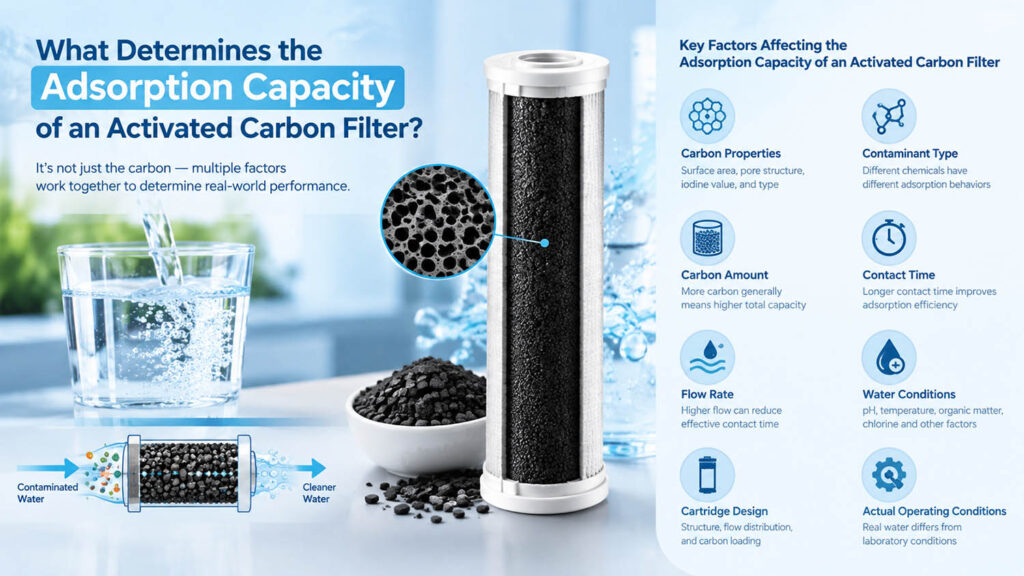
A carbon material may have a high theoretical adsorption capacity, but the performance of a finished filter cartridge depends on how much carbon is used, what contaminant is being removed, how fast water flows through the cartridge, and how the water reaches the carbon.
This is why two activated carbon filters using similar carbon materials can have very different service lives.
The Carbon Itself Is Only the Starting Point
The first factor is obviously the activated carbon.
Activated carbon contains a large network of pores that provide adsorption sites. Surface area, pore volume, pore size distribution, and surface chemistry all affect how contaminants interact with the carbon.
Iodine number is commonly used as an indicator of activated carbon adsorption properties. A carbon material with an iodine value of around 1,000–1,300 mg/g, for example, has a highly developed microporous structure.
But this number does not mean that the carbon can remove 1,000–1,300 mg/g of every contaminant in drinking water.
Different chemicals have different adsorption behaviors.
So when comparing carbon materials, the more useful question is not simply “Which carbon has the highest iodine value?”, but “Is this carbon structure suitable for the contaminant we need to remove?”
A Filter Cartridge Is Not the Same as a Carbon Material
This is where the adsorption capacity of an activated carbon filter becomes more complicated.
A carbon manufacturer’s test may be performed using a specific contaminant under controlled laboratory conditions. A finished cartridge, however, has a defined size, carbon loading, flow rate, and internal structure.
For example, two cartridges could use the same activated carbon but contain different amounts of carbon.
If one cartridge contains 100 g of carbon and another contains 300 g, their total adsorption capacity cannot be expected to be the same.
The amount of carbon inside the cartridge therefore matters just as much as the properties of the carbon itself.
More Carbon Usually Means More Total Capacity
There is a simple relationship here:
More usable carbon → more available adsorption sites → greater potential total contaminant capacity.
But increasing carbon quantity is not always the best solution.
A larger amount of carbon may require a larger cartridge, increase pressure drop, or reduce the available space for other filtration layers.
For compact products, manufacturers often need to balance carbon loading with cartridge size and required flow rate.
This is one reason cartridge design matters when determining the practical adsorption capacity of an activated carbon filter.
Flow Rate Can Change the Result
Consider two identical carbon cartridges.
One operates at a relatively low flow rate, while the other operates at a much higher flow rate.
The second cartridge gives water less opportunity to interact with the carbon before leaving the filter. The adsorption process may therefore be less effective under the higher flow condition.
This does not necessarily mean that the carbon has a lower theoretical adsorption capacity. It means the cartridge is being operated under different conditions.
For this reason, adsorption performance should be evaluated together with flow rate and contact time, rather than as a single number.
The Water Entering the Filter Also Changes Capacity
Activated carbon does not work in perfectly clean laboratory water.
Real water may contain chlorine, chloramine, natural organic matter, VOCs, and many other dissolved substances.
These compounds can compete for adsorption sites.
The concentration of the target contaminant is also important. A cartridge filtering water with a relatively high contaminant concentration can reach exhaustion much sooner than the same cartridge treating water with a lower concentration.
This explains why a manufacturer’s claimed filter life cannot always be applied directly to every water source.
Why Two Carbon Filters Can Perform Differently
Imagine two cartridges with:
- the same cartridge dimensions
- the same nominal flow rate
- the same type of activated carbon
They can still perform differently.
The difference may come from carbon loading, carbon particle or fiber structure, water distribution, internal design, contact time, or manufacturing consistency.
This is particularly relevant when comparing different carbon technologies.
For example, activated carbon fiber (ACF) has a different structure from granular activated carbon. Its accessible surface and short diffusion paths can provide rapid adsorption kinetics, which can be useful in compact water filter cartridges.
The important distinction is that adsorption capacity and adsorption speed are not the same measurement.
How Should You Evaluate a Carbon Filter Cartridge?
Instead of asking only:“What is the adsorption capacity of this carbon?”
a more useful evaluation is: How much of the target contaminant can this specific cartridge remove under the intended operating conditions?
That requires looking at the complete system:
Carbon material → carbon quantity → cartridge structure → flow rate → contact time → contaminant concentration → actual water conditions
Only when these factors are considered together can the practical performance of a carbon cartridge be properly evaluated.
From Carbon Specification to Finished Cartridge
For a filter cartridge manufacturer, the goal is not simply to select activated carbon with a high surface area or iodine value.
The carbon needs to be matched to the application.
A compact faucet filter may require a different carbon structure and loading from a larger commercial cartridge. An ACF cartridge designed for rapid chlorine or organic contaminant adsorption may also use a different structure from a conventional granular carbon cartridge.
Therefore, the adsorption capacity of an activated carbon filter is ultimately a property of the carbon and the way that carbon is designed into the cartridge.
For OEM filter cartridge development, carbon selection, cartridge dimensions, media structure, target flow rate, and contaminant-removal requirements should be considered together rather than evaluated separately.

