When replacing a water filter cartridge, many buyers start by looking for a 10″, 20″, PP, carbon, or other cartridge. But the better starting point is the filter housing you already have.
The housing determines the physical cartridge size and connection. After that, the water quality, flow rate, and filtration purpose determine what type of cartridge should go inside. In other words, how to choose the right water filter cartridge for filter housing is really a two-step decision: first make sure the cartridge fits, then make sure it does the job you need.
Start With the Filter Housing, Not the Filter Media
If you are replacing an existing cartridge, the housing is usually the easiest source of information.
Check the housing label, model number, product specification, or the cartridge that was previously installed. If none of this information is available, measure the cartridge or the internal space of the housing.
The most important physical specifications are:
- Cartridge length
- Outside diameter
- End configuration
- Connection and sealing structure
A cartridge described simply as a “10-inch filter” is not enough information. Different 10-inch cartridges can have different diameters and end designs.
Make Sure the Cartridge Will Physically Fit
The first question is not whether a cartridge has better filtration performance. It is whether it can actually be installed in the housing. Length and diameter need to match the available space. The cartridge ends also need to work with the housing’s internal sealing structure.
For example, a housing may be designed for a particular DOE or SOE cartridge. A cartridge with the correct length but a different end configuration may not seal correctly.
This is why replacing a cartridge with another model that “looks similar” can sometimes cause leakage, bypass, or installation problems.
Then Decide What the Filter Needs to Remove
Once compatibility is established, look at the actual filtration requirement.
If the main problem is sediment, rust, sand, or suspended particles, a PP melt blown or pleated cartridge may be appropriate.
If the goal is reducing chlorine, taste, odor, or certain organic compounds, an activated carbon cartridge may be more suitable.
For applications requiring membrane separation, a UF cartridge may be considered.
The filter housing does not determine the filtration media. It only defines the physical constraints within which the cartridge has to work.
Don’t Choose Micron Rating by Size Alone
Micron rating is another specification that should be selected according to the water and application.
A smaller micron rating is not automatically better. A very fine sediment cartridge can create higher pressure drop and may clog quickly when the incoming water contains a large amount of sediment.
For this reason, the right micron rating should balance particle removal, flow, pressure drop, and cartridge service life. This is particularly important when the cartridge is being used as part of a multi-stage filtration system.
Flow Rate Can Change the Cartridge Design
Two systems can use the same size housing but have very different flow requirements.
A drinking water application may require relatively low flow, while a commercial application may require considerably more.
If the required flow is high, cartridge structure and filtration area become important. Depending on the application, a larger cartridge, different media structure, or a different filtration technology may be needed.
So when asking how to choose the right water filter cartridge for filter housing, don’t provide only the cartridge dimensions. The required flow rate is also useful information.
What If the Standard Cartridge Doesn’t Work?
Sometimes the existing housing is fixed, but the standard replacement cartridge does not provide the required performance.
For example, the cartridge may fit correctly but:
- clog too quickly;
- have excessive pressure drop;
- provide insufficient chlorine reduction;
- have insufficient dirt-holding capacity;
- or fail to achieve the required service life.
In this situation, changing the housing is not always necessary. A manufacturer may be able to modify the cartridge structure while keeping the external dimensions compatible with the existing housing.
Depending on the application, this can involve changing the filter media, density, micron rating, carbon material, end cap, or internal structure.
What Information Does a Manufacturer Need?
For a standard replacement cartridge, the existing cartridge and housing model may be enough.
For a custom cartridge, providing more information will make development much easier:
Housing: dimensions, model, drawing, or photos.
Existing cartridge: length, diameter, end configuration, and sample if available.
Filtration target: sediment, chlorine, odor, VOCs, bacteria, or other contaminants.
Operating conditions: flow rate, pressure, water temperature, and expected service life.
With these specifications, a manufacturer can determine whether a standard cartridge is suitable or whether a custom design is needed.
The Practical Way to Choose a Replacement Cartridge
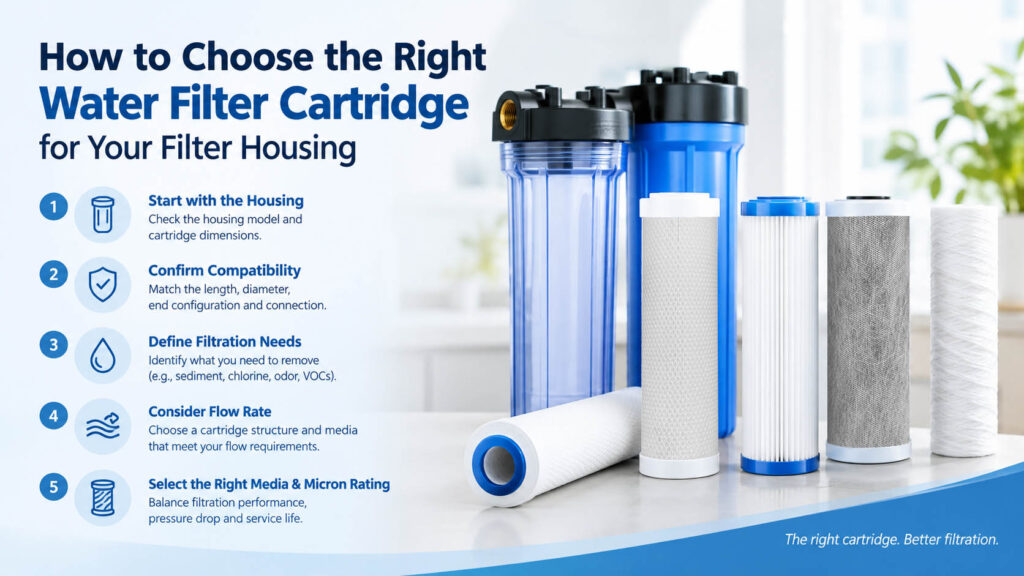
The easiest way to approach how to choose the right water filter cartridge for filter housing is to follow this order:
First: identify the housing and physical cartridge dimensions.
Second: confirm the end configuration and connection.
Third: determine what the water needs to be filtered for.
Fourth: select the appropriate media and micron rating.
Finally: check flow rate, pressure drop, and expected service life.
This approach avoids choosing a cartridge simply because it is labeled “10-inch,” “20-inch,” or “5-micron.” The correct cartridge is the one that fits the existing housing and provides the required filtration performance under the actual operating conditions.
For OEM and replacement projects, Damai tech can develop filter cartridges around an existing housing, cartridge sample, drawing, or required specifications, including PP, ACF, composite, pleated, and other cartridge structures.

