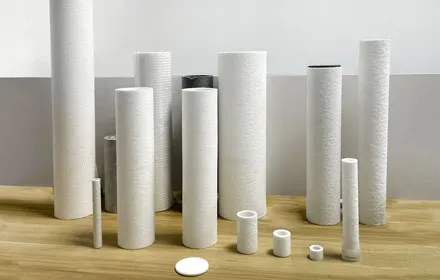
In industrial water treatment systems, filter cartridge failure is more than just a maintenance issue—it can disrupt production lines, damage downstream equipment, and increase operating costs. One of the most common and costly problems is when PP melt blown filters collapse under pressure.
Although polypropylene melt blown filter cartridges are widely used as depth-type sediment filters in RO pre-filtration, food processing, chemical treatment, and electroplating systems, not all filters are structurally equal. In many cases, when PP Melt Blown Filters Collapse Under Pressure, the root cause is related to design, raw materials, or manufacturing inconsistency.
I will explain from my personal experience why PP meltblown filters collapse under pressure, how to identify structural weaknesses, and what factors buyers should assess before purchasing to ensure reliability.
What Does It Mean When PP Melt Blown Filters Collapse Under Pressure?
When PP melt blown filters collapse under pressure, the cartridge loses its cylindrical structure due to excessive differential pressure. The filter may:
- Deform inward
- Crack along the core
- Separate layers
- Completely compress and block flow
This typically happens when the pressure drop across the filter exceeds its structural tolerance.
In industrial systems, collapse pressure may range between 2–6 bar depending on design. However, lower-quality filters may fail well below their stated rating
.
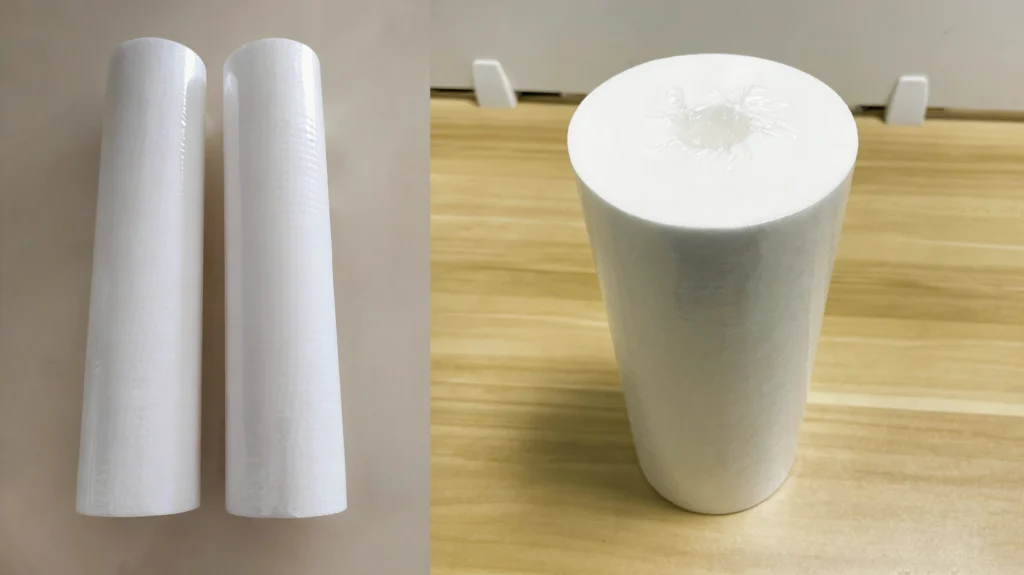
Main Reasons Why PP Melt-blown Filters Collapse Under Pressure
There is no single reason why PP melt blown filters collapse under pressure. It is usually a combination of material, structure, and operating conditions.
1. Low Fiber Bonding Strength
Melt blown filters are produced by extruding molten polypropylene into microfibers and thermally bonding them into a depth structure.
If temperature control during production is unstable:
- Fibers may not bond properly
- Internal layers become weak
- Structural integrity decreases
Poor bonding significantly increases the risk that PP melt blown filters collapse under pressure during high-flow conditions.
2. Incorrect Density Gradient Design
High-quality melt blown filters use a density gradient structure:
- Outer layer: low density for high dirt holding
- Inner layer: high density for structural support
If the density transition is poorly controlled, the inner core becomes too soft. Under high differential pressure, this inner layer compresses and leads to collapse.
Many low-cost manufacturers reduce material density to cut costs, which is one of the major reasons PP melt blown filters collapse under pressure prematurely.
3. Insufficient Inner Core Support
Standard melt-blown filters are coreless. Thin-wall designs especially require stronger internal compaction to maintain rigidity.
Without sufficient compression during winding and cooling:
- The internal fiber matrix remains loose
- Structural strength decreases
- Collapse pressure rating becomes unreliable
Thin wall versions are particularly vulnerable if not properly engineered.
4. Excessive Differential Pressure in System Design
Sometimes the filter is not defective. Instead, the system design causes overload.
Common scenarios:
- High turbidity inlet water
- No staged pre-filtration
- Blocked downstream valves
- Sudden pump surges
When differential pressure exceeds design tolerance, even well-manufactured filters may fail.
According to guidelines referenced by organizations such as NSF International, pressure testing must simulate real working conditions to ensure reliability.
5. Inaccurate Micron Rating Claims
Another hidden reason why PP melt blown filters collapse under pressure is false micron rating labeling.
Some manufacturers advertise “1 micron” filters that are actually closer to 5 microns nominal. To achieve lower cost:
- Fiber density is reduced
- Layer thickness is minimized
- Structural integrity is compromised
True micron accuracy should be verified according to testing protocols similar to those defined by ISO standards.
How to Prevent PP Melt Blown Filters Collapse Under Pressure
Preventing failure begins at both manufacturing and application levels.
Manufacturing Improvements
- Precise temperature control during fiber extrusion
- Automated density gradient calibration
- Controlled cooling and compression cycles
- Burst pressure testing for every production batch
- Raw material purity verification
A properly engineered melt blown filter should withstand at least 3–4 bar differential pressure under standard operating conditions.
Application-Level Prevention
End users should:
- Monitor pressure drop regularly
- Replace filters before reaching maximum ΔP
- Use staged filtration (20μm → 10μm → 5μm)
- Avoid sudden pump pressure spikes
Monitoring differential pressure is critical. When pressure drop exceeds manufacturer specifications, replacement is necessary to avoid collapse.
Testing Methods to Evaluate Collapse Resistance
To ensure PP melt blown filters collapse under pressure does not occur prematurely, professional manufacturers conduct:
1. Burst Pressure Test
The cartridge is subjected to increasing internal pressure until structural failure.
2. Differential Pressure Endurance Test
Simulates long-term operational stress under constant flow.
3. Compression Resistance Analysis
Measures deformation rate under static load.
4. Flow Rate vs Pressure Drop Curve Testing
Evaluates structural performance across different flow conditions.
Manufacturers that do not provide testing data often cannot guarantee real collapse pressure ratings.
Signs That Your Filters May Be at Risk
Early warning signs include:
- Rapid pressure increase
- Reduced flow rate
- Visible deformation after removal
- Filter core oval shape
If these signs appear frequently, it may indicate systemic structural weakness.
Why Collapse Resistance Matters in Industrial Systems
When PP melt blown filters collapse under pressure, consequences include:
- Downtime costs
- Membrane fouling in RO systems
- Increased maintenance labor
- Contamination risks
In pharmaceutical or food-grade applications, structural failure may even compromise compliance requirements.
Structural integrity is not just a performance metric—it is a reliability guarantee.
Final Thoughts
When PP melt blown filters collapse under pressure, the issue is rarely accidental. It is usually the result of:
- Poor fiber bonding
- Weak density structure
- Cost-cutting raw materials
- Inadequate system design
For industrial buyers, understanding these failure mechanisms is essential. Collapse resistance should be evaluated with the same importance as micron rating and flow capacity.
Choosing a manufacturer with transparent testing processes and stable production control significantly reduces long-term operational risk.