Water contaminants are present in almost every raw water source. Even when water looks clean, it usually contains particles, organics, and dissolved substances that behave differently once they enter a system.
In real projects, we rarely talk about water in general terms. We break it down by what actually affects filtration performance. Size matters more than anything else. Sometimes chemistry matters, but size usually decides the first step. That’s how most treatment systems are designed in practice.
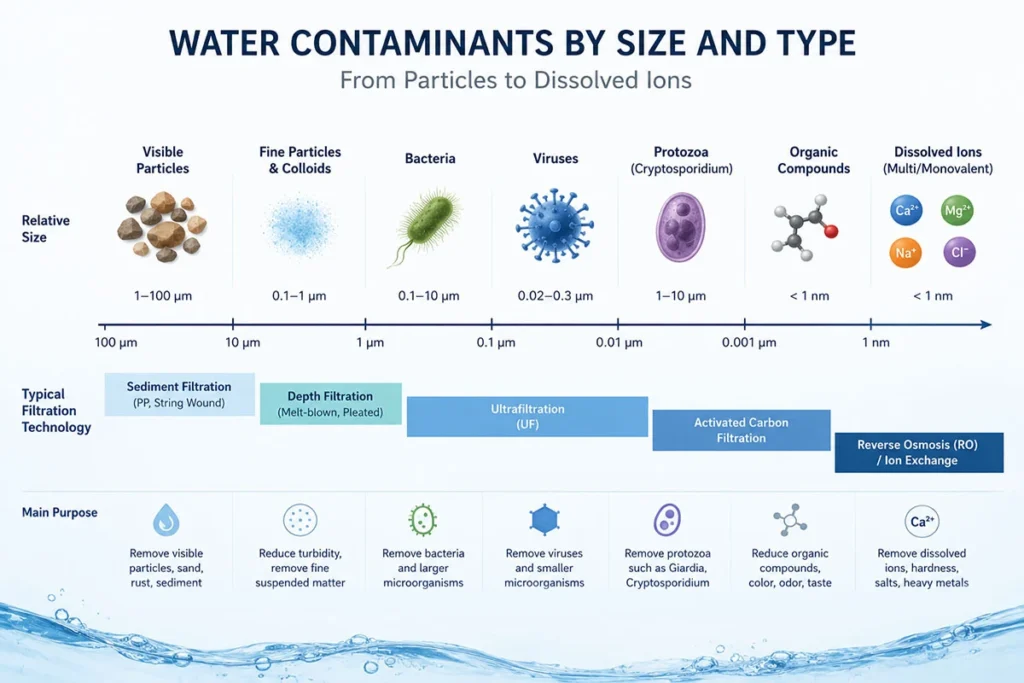
Suspended Solids (roughly 1–100 microns)
The most obvious water contaminants are suspended solids.
Sand, rust, clay, dirt… these are the obvious ones. You can often see them sitting at the bottom of a sample bottle after a few hours. Most raw water sources carry something in this range. River water is the worst. Groundwater is usually better but still not clean enough for direct use.
When particles are above 10 microns, things are relatively easy. A basic sediment filter can handle them. But once you go down closer to 1 micron, behavior changes. The water may still look clear, but filters start loading up quickly. Differential pressure rises faster than expected, especially in continuous systems.
That’s why PP melt-blown or depth filters are almost always used as the first real barrier.
Fine Particles and Colloids (0.1–1 micron)
Below visible solids, water contains fine particles and colloids. These are small enough to stay suspended for long periods. They do not settle naturally, and standard filtration often struggles with them if pretreatment is weak.
This is also the range where membrane systems start becoming sensitive. Fouling does not happen immediately, but it builds slowly over time. In many plants, it is only noticed when performance has already dropped.
From experience, this is one of the most underestimated categories of water contaminants.
Biological Contaminants (bacteria, viruses, protozoa)
Microorganisms are a different category entirely. Bacteria like E. coli sit around 0.1–10 microns. They are often used as indicators rather than the only target. Viruses are much smaller. You don’t deal with them using simple filtration alone. If they are a concern, you are already in membrane or disinfection territory.
Protozoa such as Cryptosporidium are interesting because they are physically larger, but chemically resistant. Chlorine doesn’t handle them well.
That’s something people sometimes miss. Size says one thing, resistance says another. That is why most systems combine physical filtration with UV or other disinfection methods instead of relying on a single step.
Organic Matter (natural + industrial organics)
Organics are not uniform either. Some are large and polymer-like. These are usually from natural sources like decaying vegetation. They cause color and fouling issues more than toxicity problems. Industrial or synthetic water contaminants include solvents, pesticides, and trace chemical residues. These behave differently because they are fully dissolved in water. Then there is a third group that causes trouble in municipal systems: disinfection by-products like THMs. They form when chlorine reacts with natural organics. You don’t see them directly, but they matter from a compliance perspective.
Activated carbon works well in the middle range. Once molecules get smaller, you start relying on RO or more advanced processes.
There is no single universal solution here, even though many brochures try to suggest otherwise.
Dissolved ionic water contaminants (multivalent and monovalent)
Calcium, magnesium, iron… these are the usual multivalent ions. They are the main reason for scaling in boilers and membranes. Then you have sodium and chloride. These are even more difficult because they stay stable in water and don’t react easily. At this point, physical filters are no longer enough. You are dealing with charge, not particles. RO systems and ion exchange are the standard tools here. In high-purity industries, both are often used together.
Electronics manufacturing is a good example. Even small ionic fluctuations can affect yield. That’s why conductivity control becomes more important than turbidity.
Low-Molecular-Weight Organics and Emerging Pollutants
Some water contaminants exist at extremely low concentrations but still matter over time.
PFAS is the obvious example. Very stable, very persistent, and difficult to remove.
There are also pharmaceutical residues and other trace organics that behave similarly. Concentrations are low, but they accumulate over time. These are not always visible in standard water reports, which is part of the problem.
Treatment here usually involves a combination of RO and adsorption media. Sometimes advanced oxidation is added, but that depends on system design and cost constraints.
E. coli and indicator organisms
E. coli is not just a contaminant. It is more of a signal. If it shows up, it usually means the system has a bigger upstream issue.
Cryptosporidium is another example. It is resistant to chlorine, which surprises people outside the water industry. Physical removal is the only reliable method. This is why modern systems don’t rely on a single barrier. They stack multiple ones.
Size-based filtration logic
If you simplify everything, most systems follow the same logic:
- Large particles are removed first.
- Fine particles come next.
- Microorganisms require membranes or disinfection.
- Dissolved substances require RO or ion exchange.
It sounds simple, but in practice each step affects the next one.
If prefiltration is weak, membranes fail early. If organic load is high, carbon gets exhausted quickly. If ions are not controlled, scaling becomes unavoidable. There is no isolated stage in a real system.
MAIFILTER perspective
In most industrial setups, filtration is not a single product. It is a chain of components working together. Sediment filters handle the obvious load. Carbon filters deal with organics. Membranes take care of biological and dissolved fractions. Our focus is usually on making sure each stage is stable enough so the next one is not overloaded. That’s where most system failures actually start.
Summary of water contaminants
| Category | Typical scale | What actually matters |
| Sand, rust | 1–100 µm | Flow blockage |
| Fine particles | 0.1–10 µm | Membrane fouling |
| Bacteria | 0.1–10 µm | Biological risk |
| Viruses | <0.3 µm | Membrane barrier |
| Organics | molecular | adsorption / RO |
| Ions | dissolved | conductivity control |
Summary
Water treatment is often described as a set of technologies. In reality, it is more about managing interactions between different levels of contamination. Once you see it this way, filter selection becomes much more logical—and less guesswork.