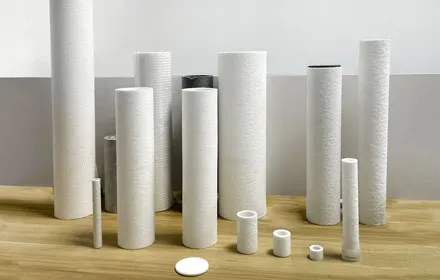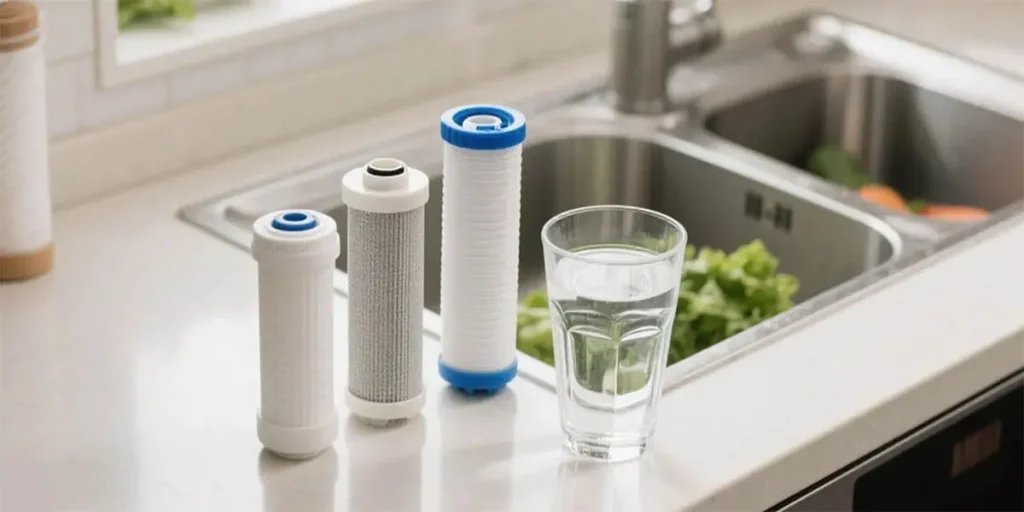
Activated carbon is found in most home water filters. You’ve probably seen phrases like “contains activated carbon filter” or “filtered through activated carbon” in the product descriptions. If you open up the filter, you’ll likely find black powder or granules inside — that’s activated carbon. While it may look simple, why has it become a standard feature in nearly all water filtration devices?
What is Activated Carbon?
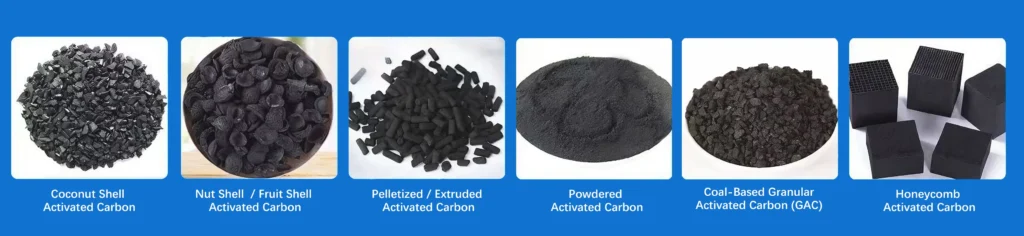
Activated carbon is not the same as regular charcoal; it’s a specially processed carbon material. It is made from a variety of raw materials, including coconut shells, fruit pits, wood, and coal — all of which are rich in carbon.
The term “activated” refers to the treatment process it undergoes. Firstly, high-temperature carbonization converts organic substances into carbonaceous materials with porous structures. Then, a process known as gas activation is carried out at high temperatures using steam or carbon dioxide to further process the materials, thereby forming a complex network of micro-pores within the material. These tiny but numerous micro-pores give rise to a large surface area: the internal surface area of activated carbon per gram can reach 800 to 1500 square meters, equivalent to the size of a small football field.
This special structure gives activated carbon its remarkable adsorption capability. When water passes through a filter containing activated carbon, harmful substances like organic pollutants, chlorine residues, and odor molecules are “magnetically” attracted to the surface of the carbon. This process is fast and efficient, and it works for various contaminants, making activated carbon a core material in most water filtration systems.
How Activated Carbon Works in Water Filtration
Activated carbon’s ability to purify water comes down to its “adsorption” process, which involves both physical and some chemical adsorption mechanisms.
Physical Adsorption
Physical adsorption occurs through van der Waals forces between molecules. Although these forces are weak, the vast surface area of activated carbon amplifies their effectiveness. Waterborne pollutants such as residual chlorine and certain harmful chemicals are firmly “attached” to the surface of the activated carbon.
Chemical Adsorption
Some advanced activated carbon filters also incorporate silver ions to prevent bacteria and mold growth or mix in alkaline or acidic substances to enhance the adsorption power. By combining these techniques, modern filters not only purify water but also improve its taste and eliminate odors, improving the overall drinking experience.
Why is Activated Carbon Ubiquitous in Water Filters?
Activated carbon can be found in almost every water filtration system. This is not only because of its excellent adsorption capacity, but also because it is affordable, easy to use and has a wide range of applications. Firstly, its raw material supply is abundant, and the manufacturing process is mature, making it an economical filtering material. Secondly, the structure of the activated carbon filter is simple, and the maintenance workload is small – they only need to be replaced regularly, which makes them very suitable for daily household use.
Another advantage is that activated carbon filters don’t require high water pressure, allowing them to filter large amounts of water quickly without affecting the flow rate. This is especially important in households where “instant filtration and drinking” is needed. Even more impressive, activated carbon is a natural material, which gives it an eco-friendly edge. Used filters can be “reactivated” at high temperatures to restore their adsorption properties, though this process is uncommon in households, it has considerable resource recovery potential in industrial applications.
The Importance of Replacing the Filter
While activated carbon is highly effective, it’s not infinite. Each piece of activated carbon has a limit to its adsorption capacity. Over time, as the filter is used more frequently, the pores within the carbon become clogged with pollutants, reducing its adsorption power. After this, continuing to use it will not only lead to a significant decline in filtration efficiency, but also may cause the “pollutant backflow” phenomenon, that is, the harmful substances previously adsorbed on the filter material will be released back into the water, thereby causing “secondary pollution”.
For this reason, activated carbon filters must be replaced according to the manufacturer’s instructions. The recommended replacement period varies slightly by filter cartridge manufacturer, But usually, it needs to be replaced within 1 to 3 months, or after filtering several thousand liters of water. Furthermore, suppose a filter has been unused for an extended period. In that case, it’s a good idea to flush out a few liters of water before using it again to remove any potential bacteria or contaminants that may have built up in a humid environment.