In industrial and commercial water treatment, selecting the right micron rating or filter media is only half the battle. If your filter doesn’t create a perfect, airtight seal inside the housing, unfiltered water will find the path of least resistance. This leads to fluid bypass, rendering your entire water filtration system ineffective.
The sealing integrity of your system comes down to a mechanical choice: DOE (Double Open End) versus SOE (Single Open End) filter cartridges.
Whether you are protecting sensitive Reverse Osmosis membranes, treating municipal water, or managing high-purity process water, this guide breaks down the technical differences, pros, and cons of DOE vs SOE filter cartridge configurations to help you optimize your water filtration vessel.
What is a DOE Water Filter Cartridge?
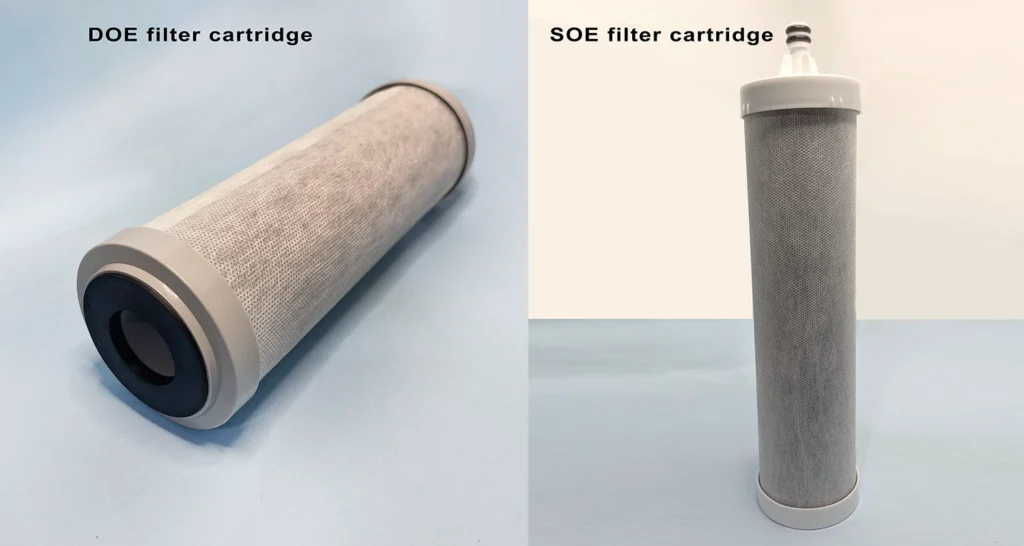
A DOE (Double Open End) water filter cartridge features a hollow, cylindrical design that is completely open at both the top and bottom. It does not have any molded plastic adapters or locking mechanisms.
How the Seal Works
Because both ends are open, a DOE filter relies entirely on the internal hardware of your water filter housing to create an axial seal.
The cartridge is slid over a central tie-rod inside the vessel.
Flat gaskets (typically made of EPDM, Buna-N, or Silicone) are placed on both flat ends of the filter.
A top compression plate or spring assembly is tightened down from the lid, squishing the gaskets against the housing’s internal knife-edge seats.
Applications in Water Treatment
DOE cartridges are the traditional workhorses for non-critical water filtration. They are highly effective for municipal water sediment removal, cooling tower makeup water, and coarse pre-filtration (5 to 20 microns) where a fraction of a percent of fluid bypass will not compromise the final product.
What is SOE Water Filter Cartridge?
An SOE (Single Open End) water filter cartridge is open at the bottom end but completely sealed off (closed) at the top end. The open end is engineered with a high-precision, molded plastic adapter.
How the Seal Works
Instead of relying on vertical pressure from a tie-rod, an SOE filter utilizes a radial seal driven by dual O-rings.
The adapter end is pushed directly into a machined tubesheet at the bottom of the filtration vessel.
The O-rings expand horizontally against the walls of the socket, creating a watertight, leak-proof barrier.
The closed top end often features a “fin” or “spear” that fits into an alignment guide at the top of the housing to prevent shifting under high flow rates.
Common SOE Adapter Codes for Water Systems
Code 7 (226 O-Rings / Locking Bayonet / Fin): The industry standard for high-pressure water systems. It locks mechanically into place with a twist.
Code 3 (222 O-Rings / Push-Fit / Flat Cap): A standard push-fit adapter ideal for steady-flow commercial water purification.
Quick Comparison: DOE vs SOE Filter Cartridge
If you need a fast breakdown of how DOE and SOE configurations perform in water treatment systems, see the core differences below:
| Technical Feature | DOE (Double Open End) Filter | SOE (Single Open End) Filter |
| Sealing Type | Axial compression against flat gaskets | Radial sealing via dual O-rings |
| Water Bypass Risk | Moderate to High (if misaligned) | Virtually Zero |
| Pressure Shock Tolerance | Poor (vulnerable to water hammer) | Excellent (mechanically locked) |
| Filter Change-Out Speed | Slower (requires handling loose rods/springs) | Rapid (simple push-fit or twist-lock) |
| Upfront Cost | Very Economical | Premium |
| Best Water Application | General sediment removal, pre-filtration | RO membrane protection, high-purity water |
Critical Factors: How to Choose for Your Water System
To maximize your Total Suspended Solids (TSS) removal efficiency and extend the lifespan of your downstream equipment, evaluate these three operational parameters:
1. Water Quality and Purity Standards
If your process requires absolute-rated filtration (e.g., commercial water bottling, electronics manufacturing, or ingredient water for food and beverage), SOE is mandatory. The flat gaskets on a DOE filter can deform over time, allowing microscopic particulate or bacteria to bypass the media. For nominal-rated sediment filtering where minor bypass is acceptable, DOE provides the most cost-effective solution.
2. Resistance to Water Hammer and Pressure Spikes
In industrial water loops, pumps kicking on or valves shutting rapidly create pressure surges known as water hammer.
Under a pressure spike, a DOE cartridge can compress vertically, momentarily breaking the knife-edge seal and letting dirty water downstream.
A Code 7 SOE cartridge locks into the tubesheet with bayonet tabs, ensuring the radial O-ring seal remains 100% intact even during heavy backwashing or sudden flow fluctuations.
3. Housing Compatibility and Maintenance Costs
Your existing water filter vessel typically dictates your choice. Open your housing lid: if you see a long center rod and loose top springs, it requires DOE filters. While DOE cartridges have a lower purchase price, they take longer to change out. If your facility values rapid maintenance and minimal downtime, converting to an SOE tubesheet housing can significantly reduce labor costs during filter change-outs.
Conclusion
When deciding between DOE vs SOE filter cartridges for water treatment, prioritize your system’s purity requirements and structural demands.
Choose DOE for basic, budget-friendly particle reduction where the mechanics of your housing allow for manual compression sealing.
Invest in SOE if you are protecting high-value assets like reverse osmosis membranes, running automated systems prone to pressure spikes, or enforcing strict zero-bypass water quality standards.
Are you looking to optimize your water filtration process or replace aging filter cartridges? Contact our technical engineering team today for a housing compatibility assessment, custom micron rating recommendations, and a fast commercial quote.