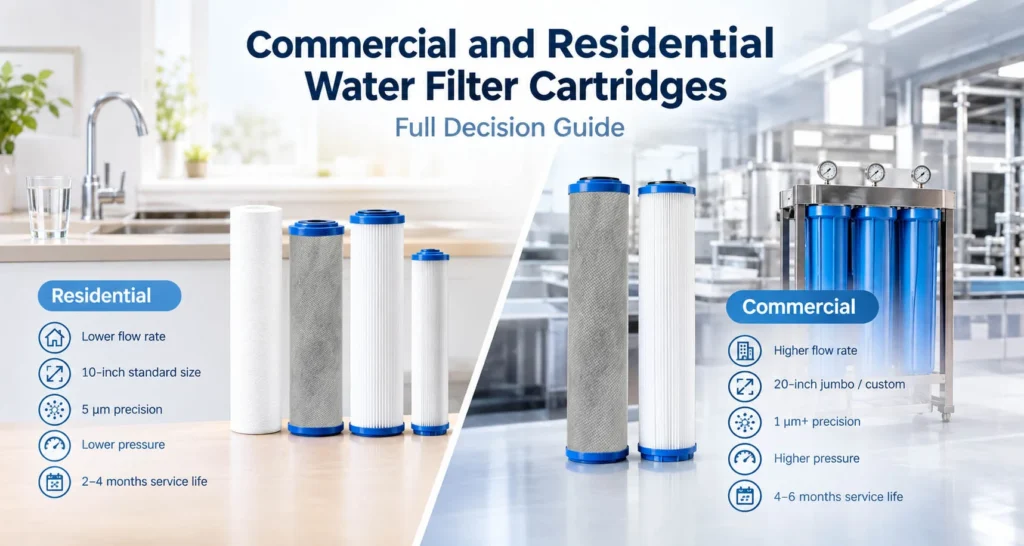
Commercial and residential water filter cartridges differ mainly in flow capacity, physical size, operating conditions, filtration requirements, service life, maintenance, and compliance requirements. Residential cartridges are generally designed for lower daily water consumption, household use, and cost performance. Commercial cartridges are typically designed for higher water demand, more frequent operation, and application-specific performance requirements in hotels, restaurants, offices, healthcare, and food and beverage facilities.
1. Core Working & Flow Capacity Difference
Residential filter cartridges are designed for intermittent domestic water demand. They are commonly used in under-sink systems, whole-house residential filtration, refrigerators, and other household applications. Their flow rate depends on the cartridge type, size, filter media, and system design.
Commercial filter cartridges are often designed for higher and more frequent water demand. They can be used in commercial buildings, restaurants, hotels, and other facilities where water consumption is higher. However, there is no fixed flow range that defines a commercial cartridge. Cartridge structure, filtration area, media selection, and pleating density are selected according to the required flow and acceptable pressure drop.
2. Physical Size & Structural Design
Residential cartridges mainly adopt 10-inch standard sizes with compact dimensions. They fit small standard housings for under-sink and countertop filters, featuring lightweight structures and easy manual replacement for ordinary household use.
Commercial cartridges often use 20-inch jumbo sizes or high-flow customized versions. Many commercial systems adopt multi-cartridge parallel housing structures to meet larger water volume demands. However, cartridge size alone does not determine whether a cartridge is commercial or residential. The outer casing and internal filter structure are selected according to flow, pressure, capacity, and application requirements.
3. Filtration Precision & Water Quality Standard
Residential cartridges commonly use filtration ratings such as 5 μm, depending on the application. They may focus on removing sediment, residual chlorine, odor, or other household contaminants depending on the filter media and design.
Commercial applications may require different filtration ratings according to the water quality and application. Some commercial cartridges use 1 μm or finer filtration to remove smaller particles, while others use larger micron ratings to maintain higher flow and lower pressure drop. Customized commercial cartridges may also use multi-stage or composite filtration to handle more complex water conditions.
The appropriate filtration precision should therefore be selected according to the target contaminants, required flow, and overall system performance.
4. Operating Pressure & Durability
Residential cartridges are commonly used with conventional household water pressure, but the actual operating pressure depends on the cartridge and housing specifications. Service life also varies with water quality, water consumption, and cartridge capacity.
Commercial cartridges may be designed for higher operating pressures or higher water throughput, depending on the system. Their structural design and materials can be optimized for longer operating periods and demanding working conditions. However, there is no universal pressure range or service life that applies to all commercial cartridges.
5. Replacement Cycle & Maintenance Rules
Residential cartridges follow flexible replacement cycles based on household water consumption and water quality. Home users typically replace filters according to the manufacturer’s recommendations, changes in water taste, reduced flow, or rated capacity.
Commercial cartridges generally require more structured maintenance because of higher water consumption and more frequent operation. Food and beverage, healthcare, and other regulated facilities may have specific maintenance and replacement procedures based on their equipment, hygiene requirements, or local regulations. Replacement records may also be maintained for quality and operational control.
6. Certification & Compliance Requirements
Residential cartridges may require food-contact or drinking-water-related certifications depending on the product and target market.
Commercial cartridges may need specific certifications or compliance documentation depending on the application and destination market. NSF/ANSI 42, NSF/ANSI 53, or other applicable standards may be relevant for certain drinking-water filtration products. FDA requirements may apply to materials used in food-contact applications. CE and UKCA requirements depend on the applicable product regulations and should not be considered mandatory for every commercial filter cartridge.
Public facilities, catering businesses, and healthcare institutions may have stricter documentation and compliance requirements, making appropriate certification and technical documentation important for commercial projects.
7. Customization & MOQ Difference
Residential cartridges are often highly standardized with common sizes and specifications, supporting small-batch retail and replacement applications with relatively low MOQ.
Commercial projects often require custom size, filtration precision, flow matching, media or layer structure, end cap and connection design, logo printing, and customized packaging based on equipment and application requirements. Customized commercial cartridges may have higher MOQ due to tooling, material preparation, and production setup costs.
Quick Comparison Table: Commercial vs Residential Filter Cartridges
| Comparison Item | Residential Filter Cartridge | Commercial Filter Cartridge |
| Typical Flow Rate | Lower flow, often intermittent use | Higher or more frequent flow, depending on system design |
| Standard Size | 10 inch standard | 15~20 inch jumbo / high-flow custom, but other sizes are also available |
| Filtration Precision | Commonly 5 μm, application-dependent | 1 μm / high precision or other ratings depending on application |
| Working Pressure | Depends on cartridge and housing specifications | Depends on cartridge, housing, and system design |
| Service Life | Depends on water quality and usage | Depends on water quality, flow, capacity, and operating conditions |
| Core Certifications | Depends on product and target market | Depends on application and target market |
| Replacement Rule | Flexible household cycle | More structured maintenance and replacement schedule |
| Application Scenarios | Family, apartment, residential water dispenser | Hotel, restaurant, hospital, office, food and beverage facilities |
How to Choose: Commercial or Residential Cartridge?
Choose residential cartridges if:
For family daily drinking, apartment whole-house filtration, small intermittent water usage, and cost-sensitive household scenarios without specific commercial compliance requirements.
Choose commercial cartridges if:
For business venues with higher or more frequent water demand, public facilities requiring specific compliance documentation, catering and healthcare applications with structured maintenance requirements, or systems requiring higher flow and application-specific filtration performance.
Conclusion
The essential difference between commercial and residential water filter cartridges is usage intensity, system requirements, and compliance needs. Residential cartridges focus on household water demand, ease of replacement, and cost performance, while commercial cartridges focus more on flow requirements, operating conditions, capacity, maintenance, and application-specific performance.
B2B purchasers should match cartridge specifications according to actual water flow, operating hours, water quality, equipment requirements, applicable certification requirements, and maintenance conditions to avoid insufficient filtration performance or unnecessarily frequent replacement.

